Workflow for AI Citation Cleanup: Practical Guide
Use this workflow for AI citation cleanup to fix conflicting business facts, resolve duplicates, and monitor AI and Google visibility.
By RankSimply ·
Quick answer: A workflow for AI citation cleanup starts by documenting the incorrect answer or source, creating one verified business record, correcting the website and major profiles, resolving duplicates, and monitoring the same queries over time. RankSimply helps local businesses track recommendations and coordinate the profile, review, citation, schema, competitor, and content work behind those corrections.
AI citation cleanup is not a task where you edit an AI assistant's answer directly. It is entity-data operations: find the incorrect business fact, identify the public records that conflict with your verified information, fix the records you control, request corrections elsewhere, and track whether search and AI recommendations begin repeating the corrected facts.
What is an AI citation cleanup workflow for a local business?
An AI citation cleanup workflow is a repeatable process for reconciling inaccurate business information across your website, business profiles, directories, structured data, and other public sources that may inform search results or AI-generated answers. Its job is to give customers and systems one clear, location-specific record of who your business is and what it offers.
In local search, a citation is an online mention of a business's identifying details. It often includes a name, address, phone number, website, category, hours, or service area. It is different from:
- Academic citations: References that identify the source of a research claim.
- Citations in AI-generated writing: Links or source labels supporting a statement in a generated response.
- Local-business citations: Public records that help identify a business, its location, and its services.
A local citation problem can make a business look closed, moved, unavailable in a service area, or confused with a former location or similarly named company. Cleanup means reconciling those records rather than submitting the same listing to every directory without a plan.
Businesses generally cannot directly force ChatGPT, Gemini, Claude, Perplexity, Copilot, Grok, or another third-party AI model to change or remove a cited source. The practical route is to correct the public facts that support the wrong answer and keep a record of the evidence before and after each fix.
How do you tell whether the problem is an AI answer, a source listing, or your own website?
Start by separating the observed error from its likely source. An inaccurate AI answer may repeat a wrong directory listing, misunderstand an unclear website page, merge two similar businesses, or state a fact without showing a visible source; each problem calls for a different correction path.
Capture the exact answer before changing anything. Record the prompt, platform, market wording, date, business name used, answer text, visible citations, and competitors named. A screenshot is useful, but the written prompt and source URLs make the result repeatable.
Then classify the issue.
| Finding | Likely problem | First action |
|---|---|---|
| AI gives an old phone number | Stale profile or directory data | Search the number and correct the strongest matching sources |
| AI lists a former address | Old location record or duplicate | Check owned pages, major profiles, and duplicate listings |
| Search result has the wrong suite number | Inconsistent location formatting | Set one approved address format and update primary records |
| AI recommends the wrong category | Weak or conflicting category signals | Review major profile categories and service pages |
| AI merges two businesses | Name, location, or entity confusion | Clarify brand details, location pages, and duplicate records |
| Business is omitted from relevant answers | Information gap, weak corroboration, or competitor advantage | Compare cited sources and build the next remediation task |
Do not assume that a visible AI citation is the only source behind an answer. Treat it as evidence worth inspecting. If the answer cites your website, begin with the page it names. If it cites a directory or profile, inspect that record and search for the same error across other public sources.
For a structured baseline, see how to audit AI search presence across recurring local-business prompts before assigning cleanup work.
Which business facts should you audit before you change anything?
Audit the business identity facts that customers use to contact, locate, and evaluate you before editing listings. A single approved record prevents different staff members, agencies, or location managers from correcting the same detail in conflicting ways.
Create a source-of-truth record for every location. Keep it in a controlled document that has an owner and a change date.
| Field | What to record | Common conflict |
|---|---|---|
| Legal business name | Registered name where needed | Rebrand leaves an old name online |
| Public-facing name | Customer-facing business name | Unnecessary keyword additions or abbreviations |
| Address or service area | Exact public address or defined service area | Moved location or outdated service-area city |
| Phone number | Primary public contact number | Old tracking or former office number |
| Website URL | Preferred location or main URL | Old domain or wrong location landing page |
| Business category | Primary and relevant secondary categories | Incorrect category inherited from an old listing |
| Operating hours | Regular and special hours | Old hours after a schedule change |
| Services | Accurate service names and availability | Services listed for the wrong location |
| Brand description | Short approved description | Former positioning or unsupported claims |
Use exact information where it matters, but do not force identical punctuation into every system. For example, an address may display “Suite 200” in one profile and “Ste 200” in another because of a field constraint. The building number, street, suite, city, postal code, phone, URL, category, and service facts should still identify the same location.
The most frequent conflicts are predictable: a moved location, an old phone number, an inconsistent suite number, a rebrand, a duplicate Google Business Profile, an incorrect category, or an outdated service area. Put each known conflict in the source-of-truth record before asking anyone to update listings.
How should you prioritize conflicting citations and duplicate listings?
Prioritize citation cleanup by fixing high-authority sources with serious errors, duplicate risk, available ownership access, and repeated appearance in search or AI results. This sequence protects customers first and avoids spending time on low-value listings while your website or primary profile still shows the wrong facts.
Score each issue using five questions:
- Source authority: Is this your website, a major business profile, a map result, an industry profile, or a low-traffic directory?
- Error severity: Could the error send a customer to the wrong location, phone number, hours, service, or business?
- Duplicate risk: Does the record split reviews, create two map entities, or confuse the current location with a closed one?
- Ownership and access: Can your team edit the record now, or does it require a support request or ownership process?
- Observed repetition: Does the source or the same wrong fact appear in AI answers, search results, maps, or customer reports?
A former address on the website, a major profile, and a duplicate map listing is urgent because it affects both discovery and customer action. A wrong description on an obscure directory is lower priority unless it appears repeatedly in search results or AI citations.
Treat duplicate listings as entity conflicts
A duplicate is not simply an extra directory entry. It can split customer reviews, preserve an old address, or establish a second public identity for the same location. Confirm that the two records truly represent the same business before requesting a merge, closure, or correction.
Google's guidance on local business structured data explains the business details that can be marked up on a site. Use that same location-specific discipline when evaluating whether two public records refer to one business or two separate locations.
What is the step-by-step workflow for AI citation cleanup?
A reliable workflow for AI citation cleanup moves from evidence to diagnosis, remediation, documentation, and repeated observation. Follow the same sequence for every location so the team can explain why a change was made and verify whether the public record now matches the approved facts.
- Capture the evidence. Save the original prompt, answer, date, platform, market wording, visible sources, and exact inaccurate claim. Include a search result or map result when it shows the same problem.
- Diagnose the source. Determine whether the error appears on your website, a primary business profile, a third-party directory, an old location page, a review, or multiple sources.
- Establish canonical facts. Confirm the location's approved name, address or service area, phone, URL, categories, hours, services, and description in the source-of-truth record.
- Correct owned assets first. Update the website, location pages, contact pages, profile links, and any structured data that repeats the outdated fact.
- Correct major profiles. Update the profiles that customers and search engines are most likely to encounter. Use the approved record rather than rewriting details from memory.
- Request or submit third-party corrections. Claim, edit, or report inaccurate directory records where the platform supports it. Save confirmation emails, ticket references, and live URLs.
- Consolidate true duplicates. Request removal, closure, or merger only after checking that the duplicate represents the same business or former location.
- Update schema and supporting content. Align location pages, service pages, FAQ content, organization details, and local business structured data with the approved record.
- Log every change. Record the URL, old fact, new fact, change method, owner, date submitted, date verified, and remaining issues.
- Monitor the original question. Re-run the same prompts at recurring intervals and compare the facts, cited sources, recommendations, search results, and competitors.
Google recommends that structured data reflect the visible page content and comply with its structured data policies. Do not use schema to declare a location, service, or business fact that your pages do not support.
For recurring wrong AI descriptions, use a process for correcting inaccurate business information in AI assistants to keep the finding, source analysis, and fixes connected.
Which sources should you fix first when your business information conflicts?
Fix the owned website and location-specific structured data first, then major business profiles and high-impact duplicate listings, followed by relevant directories and supporting pages. This order gives every later correction a clear reference point and reduces the chance that third-party records continue pointing customers to outdated owned information.
The best order depends on the error, but the following comparison keeps remediation focused.
| Remediation area | Control level | Verification method | Main limitation |
|---|---|---|---|
| Owned website and schema | Direct | Check live page, markup, and search rendering | Does not correct third-party records |
| Major business profiles | Direct after ownership | Check live profile and submitted edits | Review or processing can delay changes |
| Directory cleanup | Varies by publisher | Check listing URL and correction status | Low-value directories may have little impact |
| Review-response work | Direct for owned profile responses | Check published response and recurring themes | A response does not change the original review |
| AI-answer monitoring | Observation only | Re-run documented prompts and compare sources | Does not directly edit model output |
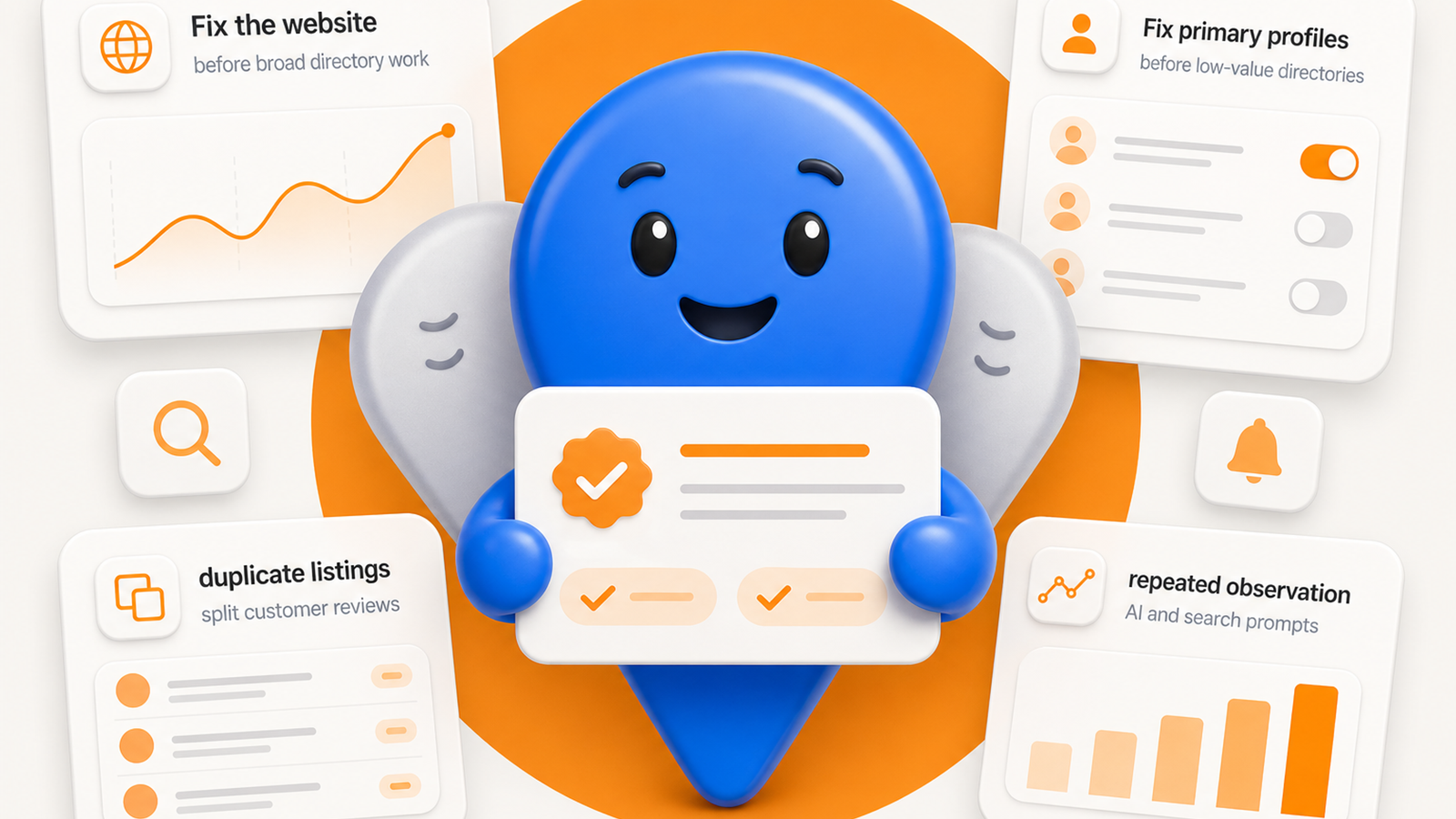
Fix the website before broad directory work
Your own site should clearly state the current business identity, location details, services, hours where relevant, and contact information. A former office address on a contact page can undermine accurate profile work elsewhere. Review location pages, footer details, staff pages, PDFs, booking pages, and old blog posts that still carry contact information.
Fix primary profiles before low-value directories
Major profiles often have more customer visibility and are more likely to become a source for maps, search snippets, reviews, or AI citations. Focus on profiles tied to your category, market, and customer journey before working through a long list of generic directories.
Use reviews as corroboration, not a substitute for corrections
Reviews can reveal that customers are encountering outdated hours, phone numbers, locations, or service descriptions. Reply accurately where a response is appropriate, but correct the underlying profile or page as well. See how to build a review strategy that supports accurate AI recommendations when review themes expose recurring information gaps.
How do reviews, profiles, schema, and on-page content support citation cleanup?
Reviews, profiles, schema, and on-page content support citation cleanup by corroborating the same accurate business identity across places customers and search systems can inspect. They work best as a connected record: profiles identify the business, pages explain its services and locations, schema clarifies page facts, and reviews provide customer evidence about real experiences.
Use each asset for its proper job:
- Business profiles: Keep contact details, categories, hours, services, and URLs current.
- Location pages: Give each real location its own accurate address, phone, service details, and directions where appropriate.
- Service pages: Explain what the business actually offers without assigning services to locations that do not provide them.
- Structured data: Mark up facts that are visible and supported on the page.
- Reviews and replies: Spot recurring customer confusion, respond helpfully, and correct the source that caused it.
- Brand descriptions: Use a consistent, accurate explanation of the business across profiles where descriptions are available.
Google's documentation on AI features in Search advises site owners to continue following foundational Search guidance rather than creating separate pages solely for AI features. For local businesses, that makes source accuracy the practical priority: publish clear pages for customers, keep business facts aligned, and correct records that contradict them.
How can you verify that the cleanup improved visibility without promising an AI update?
Verify cleanup by confirming that corrected records are live, then monitoring the same AI and search questions with the original context preserved. This shows whether public source data is consistent and whether observed answers, citations, and recommendations are changing over time without treating one changed response as proof of a single cause.
Use a monitoring checklist for each business and location:
- Original prompt and exact wording
- Business-name variants, abbreviations, and former names
- Market or location context used in the question
- Competitor comparison prompts
- Platform checked and date checked
- Answer text, recommendation status, and fact accuracy
- Visible source URLs and source type
- Current search, map, or profile evidence
- Change dates, correction tickets, and verified live updates
- Recurring review interval
A useful comparison prompt asks the same buyer question while naming competing businesses or service alternatives. It helps distinguish a factual correction problem from a broader visibility gap. Record competitors that appear, the reasons given, and sources shown; do not assume a competitor mention came from one directory alone.
RankSimply tracks selected prompts across ChatGPT, Claude, Gemini, Perplexity, Grok, Copilot, and Google AI Overviews, then keeps observed answers and citations alongside profile, review, citation, schema, competitor, and content work. That creates one operating record for the remediation work rather than a folder of disconnected screenshots.
What should you document so citation errors do not return?
Document the approved business facts, every identified conflict, every correction request, and the recurring checks used to verify live records. A shared log prevents old details from returning during a rebrand, location move, staffing change, website migration, agency handoff, or bulk listing update.
Use one row per issue with these fields:
| Field | What to document |
|---|---|
| Location and entity | Exact business and location affected |
| Error | The inaccurate fact and where it appeared |
| Evidence | Prompt, screenshot reference, URL, or customer report |
| Priority | Authority, severity, duplicate risk, and repetition score |
| Approved fact | Source-of-truth value to publish |
| Fix owner | Person or team responsible |
| Action | Edit, claim, report, merge, redirect, or content update |
| Dates | Found, submitted, live, and rechecked dates |
| Result | Live record status and later monitoring observations |
Assign one person to approve changes to the source-of-truth record. This matters most for multi-location businesses, where a correct company-wide description can still be wrong for a specific branch, service area, phone number, or category.
The next practical step is to build the source-of-truth record for one location, capture the most important inaccurate result, and work through the priority sequence before expanding the process. If you need a repeatable baseline across locations or clients, monitor AI recommendations and coordinate local visibility improvements can organize the evidence and remediation work.
Frequently asked questions
Can I ask ChatGPT or Gemini to remove an incorrect citation about my business?
You can report feedback through an AI product's available feedback tools, but businesses generally cannot directly require a third-party AI model to remove or change a cited source. The effective cleanup path is to document the error, correct inaccurate website, profile, directory, and schema data, resolve duplicates, and monitor the same prompt over time.
How long does it take for corrected business information to appear in AI answers?
There is no fixed timetable for corrected business information to appear in AI answers. Verify first that the owned page, profile, or directory record is live, then re-run the original prompt at scheduled intervals and record the answer, visible sources, and factual accuracy. This creates a clear history of the correction and later observations.
Should I fix every business directory before updating my website?
No. Update your website and other owned assets first because they provide the approved reference record for later profile and directory corrections. Next, prioritize major profiles, high-severity errors, true duplicates, and sources that repeatedly appear in search or AI results. Low-impact directories come later unless they contain a serious customer-facing error.
What information should be identical across my business listings?
Listings should identify the same business using accurate legal and public-facing names, address or service area, phone number, website URL, categories, operating hours, services, and brand description. Formatting can differ because platforms use different fields, but the underlying facts must not conflict, especially for location, contact, category, and service availability.
How often should I audit citations for AI visibility?
Audit citations whenever a business moves, rebrands, changes phone numbers, adjusts service areas, opens or closes a location, or identifies inaccurate customer-facing information. For ongoing monitoring, repeat a documented set of AI and search prompts at a regular interval, then review source changes, competitors, profiles, reviews, and unresolved duplicates together.