What Affects AI Business Recommendations
What affects AI business recommendations? Learn how prompts, location, sources, reviews, citations, content, and schema can influence inclusion.
By RankSimply ·
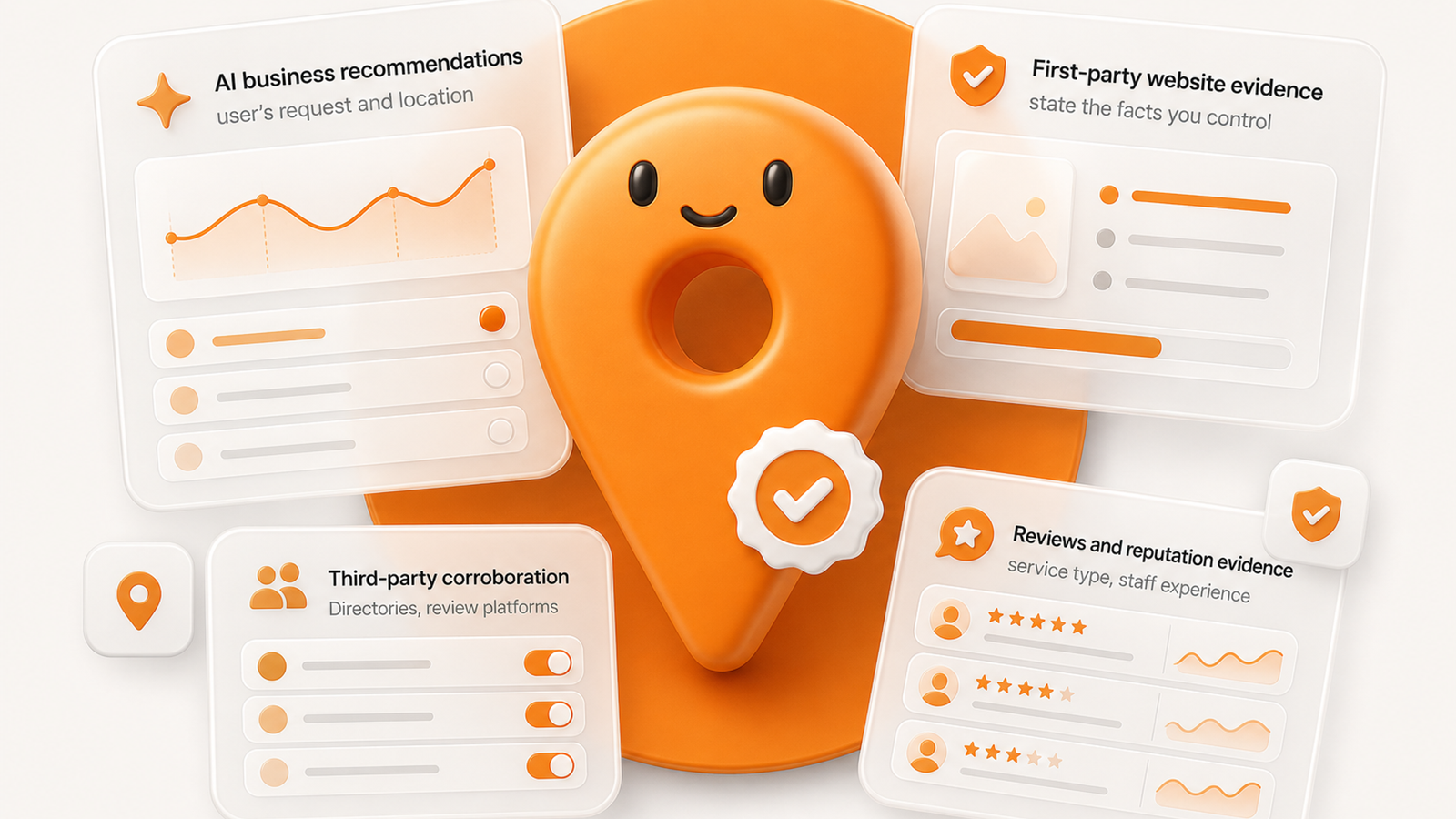
AI business recommendations reflect the user’s request and location, the assistant’s available sources and retrieval behavior, and the clarity, credibility, and relevance of a business’s information across its website and third-party sources. Clear, consistent services, service areas, reputation, and distinguishing facts give AI assistants a stronger record to identify and recommend.
Record AI answers by prompt, market, date, platform, search mode, and available sources. This turns mentions, citations, and recommendations into a useful visibility baseline for measuring changes over time.
There is no public, universal weighting system shared by ChatGPT, Gemini, Claude, Perplexity, Copilot, Grok, and Google. Treat AI visibility as a measurement problem first: define the prompts that matter, record what each system returns, inspect the evidence behind recurring competitors, fix factual gaps, and measure the pattern again.
What affects AI business recommendations? The short answer
An AI assistant can only recommend a local business when it can identify the business, understand whether it fits the request, and find enough credible information to support including it. That information may come from search results, business profiles, review platforms, directories, industry publications, the business website, and other sources available to the system.
The factors most likely to matter in practice are:
- Prompt fit: Does the business match the requested service, neighborhood, price range, urgency, audience, or other stated need?
- Location fit: Is the business clearly associated with the city, area, or service territory in the request?
- Entity clarity: Do the business name, address, phone number, website, category, hours, and services agree across important sources?
- Relevant proof: Does the web contain useful evidence about the service, local experience, team, process, reputation, and customer outcomes?
- Source availability: Can the assistant retrieve or rely on sources that mention the business and support the answer?
- Comparison context: Do competing businesses have clearer or more frequently corroborated evidence for that specific request?
These are not confirmed universal ranking factors. They are a practical framework for finding weaknesses that can make a business difficult for an AI system to identify or explain.
Why AI recommendations are different from traditional local rankings
A traditional Google organic ranking, a Google local-pack result, an AI citation, and an AI business recommendation are related but different outcomes. Confusing them leads to poor diagnosis.
| Outcome | What the user sees | What it means | What it does not prove |
|---|---|---|---|
| Organic ranking | A webpage in search results | Google surfaced a page for a query | The business will be recommended in an AI answer |
| Local-pack result | A business listing or map result | The listing was visible for a local search | The business fits every conversational request |
| AI citation | A source linked or named in an AI response | The source supported part of the response | The assistant endorses the cited business |
| Direct recommendation | A business named as a choice | The assistant selected it for that prompt and context | The same answer will recur for every user |
A local pack is designed to present nearby business results. A generative answer may summarize several sources, compare options, add constraints from the prompt, or decide that it lacks enough evidence to name a business at all.
Google distinguishes between content being eligible to appear in Search and receiving a particular placement in results. Its Search Essentials explain baseline technical and spam-policy expectations, but they do not provide a formula for appearing in an AI recommendation.
This overlap still matters. Strong local SEO can improve the factual signals available about a business. It should not be treated as a replacement for AI recommendation monitoring.
The evidence AI assistants can use when recommending a local business
AI systems do not all retrieve, cite, rank, or present sources the same way. Some answers visibly cite web pages; others offer little source detail. Some may use live search in certain modes, while others may rely on different retrieval paths or product features.
That is why a claim such as “reviews are an AI ranking factor” is too broad. A more accurate statement is that reviews, listings, pages, and structured data can help create clearer public evidence about a business. Whether a particular assistant uses that evidence for a particular answer should be tested.
First-party website evidence
Your website is where you can state the facts you control. A service business should make it easy to verify what it does, where it works, who provides the service, and how a customer gets started.
Useful first-party evidence can include:
- Service pages that explain the actual work offered rather than repeating broad category terms.
- Location pages when each page serves a real purpose and contains useful local information.
- Team, practitioner, attorney, technician, or credential information where it affects buyer confidence.
- Process, availability, policies, pricing ranges, financing details, or consultation information when appropriate for the business.
- Case examples, project details, or frequently asked questions that answer real customer concerns without unsupported claims.
A vague homepage can leave an assistant unable to distinguish an emergency repair provider from a replacement specialist, or a family dentist from an implant-focused practice. Clear pages may help clarify that distinction.
Third-party corroboration
A business’s own website is not the only source that can shape an answer. Directories, review platforms, local publications, trade associations, professional listings, and industry-specific sites can corroborate important facts.
The goal is not to create listings everywhere. Start with sources that are authoritative or locally relevant for your category. Check whether they show the correct business identity, service information, website, operating area, and contact details.
Third-party coverage can also reveal why a competitor appears more often. If a competitor is repeatedly described as serving a specific neighborhood, specialty, customer type, or urgent need, that language may better match the prompt being tested.
Reviews and reputation evidence
Reviews can contribute details that are hard to fit on a profile: service type, staff experience, appointment speed, local context, or a customer’s reason for choosing the business. A recent, credible review that describes a relevant service can be more useful context than an undifferentiated star total.
Do not assume review count alone causes AI recommendations. Review quality, recency, service relevance, location context, and the credibility of the review source can all affect how useful the information is to a person or system assessing a local option.
For a practical review process, see our guide to review strategy for AI recommendations.
How query context changes which businesses get recommended
Similar prompts can produce different business recommendations because the requested criteria are different, even when the user does not realize it.
Consider the difference between these requests:
- “Who is a good roofer in Toronto?”
- “Who can repair an active roof leak near North York today?”
- “Which Toronto roofing company has experience with flat commercial roofs?”
- “Who is a budget-friendly roofer for a small repair?”
Each prompt changes the evidence needed for a credible answer. Service type, neighborhood or city, budget, urgency, accessibility needs, audience, comparison criteria, and exact wording can influence what an assistant retrieves or selects.
Location assumptions matter too. “Near me” may be interpreted differently based on account settings, device signals, search mode, or the system’s available context. Record the intended market whenever you monitor a local prompt.
A broad question may generate general advice, sources, or no named businesses instead of a local shortlist. A prompt set should therefore reflect real customer decisions rather than only broad category searches.
The local signals to audit first: profiles, reviews, citations, content, and schema
Start with factual consistency before publishing more content. An assistant cannot reliably represent a business when major sources conflict about its name, address, category, service area, or operating status.
Business profiles and entity consistency
Compare the facts shown on your website and important business profiles. Review your:
- Business name
- Address or service-area designation
- Phone number
- Website URL
- Primary category and relevant service categories
- Hours and holiday hours
- Service areas
- Booking, contact, or appointment details
A small difference is not always harmful. A former phone number, a duplicate listing, an outdated address, or a category that describes a different service can create genuine ambiguity. Resolve material conflicts at the original source rather than trying to explain them away in blog content.
Reviews
Review monitoring should look beyond average rating. Inspect whether recent reviews mention the services you want to be known for, whether customers describe the correct location, and whether the review profile contains signs of outdated business information.
Businesses should respond thoughtfully to genuine reviews, especially when a response can clarify a practical issue such as scheduling or service scope. Do not pressure customers for scripted wording or manufacture reviews.
Citations and local references
Citations are mentions of the business across the web, often in directories or local listings. Audit the important sources first: major platforms in your market, relevant industry directories, professional associations, and respected local publications.
Look for missing website links, wrong categories, old contact details, duplicate records, and listings that omit a core service or location. Use citations to corroborate key business facts, then compare that evidence with the prompt-specific proof needed for a recommendation.
Content that resolves buyer questions
Content should reduce uncertainty about a customer decision. For a local business, that often means explaining who the service is for, what is included, where it is offered, how timing works, and what makes the business relevant to a specific need.
Publish distinct pages only where the business has real expertise and evidence. Thin city-page templates and broad service claims can make information less trustworthy, not clearer.
RankSimply’s local business AI search checklist outlines a practical way to review profiles, service pages, citations, reviews, and business facts before expanding content.
Schema markup
Schema markup gives search engines machine-readable context about a page and business. It can clarify details such as organization identity, local business information, services, reviews when eligible, and page relationships.
Schema is not a shortcut to AI recommendations. It cannot fix inaccurate profiles, weak service pages, or absent third-party evidence. It may help clarify facts already visible and supported on the page, so validate it and keep it aligned with the public content.
What each signal can and cannot tell an AI system
The strongest local visibility work joins several evidence types. No single signal answers every question an assistant may need to resolve.
| Signal | What it can help clarify | What it cannot prove alone |
|---|---|---|
| Business profile | Category, contact details, hours, location | Best fit for every customer need |
| Reviews | Customer experience and service-specific detail | Universal quality or current capacity |
| Citations | Identity and local or industry presence | That the service remains accurate today |
| Website content | Services, process, team, qualifications, policies | Independent reputation |
| Schema markup | Machine-readable page and entity details | Recommendation eligibility or prominence |
| Competitor comparison | Missing evidence and prompt-specific differences | Why a model made one exact choice |
This is why broad claims about an “AI ranking factor” often fail operationally. A review may help explain experience, a location page may clarify service geography, and a profile may confirm hours. Their value depends on the request and whether the information agrees across sources.
A practical workflow for improving recommendation readiness
Work from observed gaps, not a generic checklist. The table below pairs common problems with the evidence worth inspecting and a way to measure whether the work changed the pattern.
| Observable problem | Evidence to inspect | Likely improvement path | How to measure change |
|---|---|---|---|
| Business is absent for core local prompts | Prompt results, competitors, service and location pages | Clarify service and area relevance | Repeat the same prompt set by market |
| Wrong facts appear | Profiles, directories, website contact details | Correct conflicts at source | Recheck facts and answer accuracy |
| Competitor wins a specialty query | Competitor pages, reviews, listings, source citations | Build supported specialty evidence | Track inclusion for that specialty prompt |
| Business is cited but not recommended | Answer wording, cited sources, comparison criteria | Improve buyer-facing proof and differentiation | Separate citations from recommendations |
| Answers vary sharply by platform | Platform, search mode, source set, prompt wording | Diagnose each platform before changing strategy | Compare repeated checks by platform |
| Local visibility is unclear | Organic, local-pack, and AI answer records | Create one baseline across channels | Review trends by date and market |
1. Build a small prompt baseline
Choose prompts that reflect real buying situations, not only your main category. Include service, location, and decision criteria. For example, a dental practice might track separate prompts for emergency appointments, family care, implant consultations, and a specific neighborhood.
Use a manageable set. A useful baseline is specific enough to expose gaps and stable enough to repeat.
2. Record the context of every check
For each result, document the date, intended location, prompt wording, model or search mode, cited sources, businesses mentioned, recommendation language, and notable qualification in the answer.
Separate a source citation from a direct recommendation. Also separate a named business from a favorable statement that does not tell the user to choose it.
3. Diagnose evidence gaps before changing pages
When competitors recur, inspect the public evidence around the exact prompt. Do they have clearer service pages? Stronger local references? More relevant reviews? A better-defined category or service territory?
The answer may be unclear, and that is useful information. Do not assign one cause when the evidence only supports a hypothesis.
4. Improve the most credible gap
Correct identity conflicts first. Then prioritize missing service information, weak location relevance, incomplete profiles, valuable citations, review-management issues, or content gaps based on the observed pattern.
Make changes in documented groups. If every profile, page, review process, and schema element changes at once, you will not know which work may have affected later results.
5. Recheck over time and across systems
Re-run the same prompt set after search engines and source sites have had time to recrawl or update. There is no universal timeline for a profile edit or webpage change to appear in AI-generated answers. Update timing can vary by source, platform, retrieval behavior, and the specific query.
Treat changes as observations, not proof of causation. Prompt variation, model updates, changing source availability, and personalization can all be confounders.
Monitor prompts responsibly
A prompt-monitoring program should be documented and limited to a defined sample. It can show what selected platforms returned for selected prompts at a particular time; it cannot represent every user query or every customer experience.
For each check, record:
- Platform and mode used
- Intended market or location input
- Exact prompt wording
- Date of the check
- Businesses named
- Citations or sources shown
- The exact recommendation language, including qualifications or uncertainty
Use access methods permitted by the platform you are checking. Avoid collecting unnecessary personal data, and do not use personal account details or customer information as part of a monitoring record unless there is a clear business need and appropriate permission.
Keep the same core prompt set long enough to compare results meaningfully. When customer priorities change, add new prompts and track them as a separate baseline.
Turn recommendation monitoring into a repeatable local visibility process
The practical goal is not to force a model to name your business. It is to make the business easier to identify, verify, and distinguish when a relevant local question is asked.
Run the same process each month or quarter:
- Confirm priority services, markets, and customer scenarios.
- Repeat a documented prompt set across the platforms relevant to your customers.
- Separate citations, mentions, and direct recommendations in reporting.
- Audit competitor evidence only where competitors recur for high-value prompts.
- Fix the factual or proof gap with the strongest supporting evidence.
- Recheck the defined baseline and compare results by prompt, location, and platform.
RankSimply helps local and multi-location businesses monitor selected prompts across ChatGPT, Claude, Gemini, Perplexity, Grok, Copilot, and Google AI Overviews, then coordinate profile, review, citation, schema, competitor, and content improvements. Its reporting keeps observed AI answers and citations separate, so teams can assess a defined monitoring set rather than assume one result represents every customer search.
See RankSimply’s AI visibility score methodology to understand the factors used to assess a defined set of prompts and markets. RankSimply also offers a free AI visibility report with no signup.
FAQ
Do reviews affect AI business recommendations?
Reviews provide public evidence about customer experience, service types, local context, and reputation. Prioritize recent, detailed, credible reviews that match the requested service over generic praise or review volume alone.
Does schema markup make a business more likely to be recommended by AI?
Schema markup helps machines interpret business and page details when it matches visible, accurate content. Use it to clarify supported facts, then strengthen profile accuracy, service content, reputation, and third-party corroboration.
Why does an AI assistant recommend different businesses for similar prompts?
AI assistants can recommend different businesses because the prompt wording, location assumption, model, search mode, retrieval sources, timing, and personalization context may differ. A prompt that adds urgency, a neighborhood, a budget, or a specialty can materially change what evidence is relevant and which businesses fit the answer.
How long does it take for business information changes to appear in AI recommendations?
There is no fixed timeline for a business-information change to appear in AI recommendations. A profile update, new review, directory correction, or website edit may be discovered at different times by source platforms and AI retrieval systems. Record the change date, re-run the same prompt baseline over time, and avoid treating one changed answer as proof that a single update caused the result.
Is optimizing for AI recommendations different from traditional local SEO?
AI recommendation work overlaps with local SEO because both depend on accurate business information, clear service and location relevance, useful content, and credible reputation signals. The difference is measurement: AI monitoring tracks whether a business is cited or recommended for defined conversational prompts across specific platforms, while traditional local SEO also measures organic and map visibility.