Review Strategy for AI Answer Visibility
Build a review strategy for AI answer visibility with authentic feedback, consistent business facts, and repeatable monitoring.
By RankSimply ·
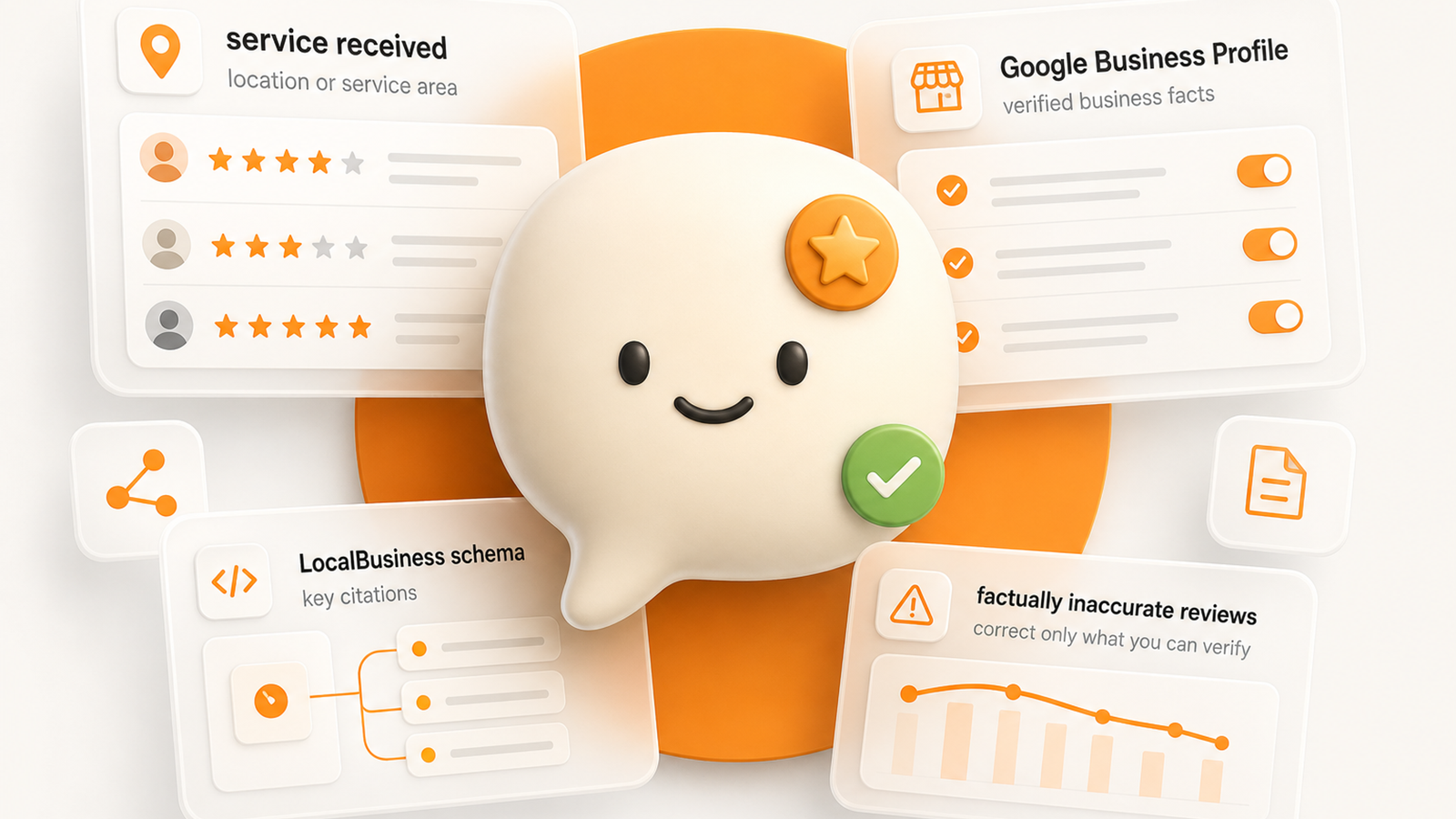
Quick answer: Authentic reviews corroborate accurate services, locations, and customer experience across public sources. Build a steady review process, keep profiles and website facts aligned, then test the same buyer prompts by market each month to check whether your business is included, described accurately, and supported by visible sources.
A review strategy for AI answer visibility is a system for collecting truthful customer feedback that confirms what your business does, who it serves, where it operates, and why customers choose it. Generic five-star volume can support trust, but it does not resolve conflicting services, locations, hours, or claims across the web.
Build review evidence that matches verified business facts, then monitor whether your business is included accurately in relevant recommendation queries.
What is a review strategy for AI answer visibility?
A review strategy for AI answer visibility connects real customer feedback with the business facts that search engines and AI assistants need to verify. It focuses on recent, detailed, policy-safe reviews, accurate public responses, and matching information across your website, Google Business Profile, directories, and structured data.
The goal is corroboration. A customer review can independently describe a service, decision factor, or outcome. Your website can explain that same service in full. A Google Business Profile, directory listing, and LocalBusiness schema can confirm core entity facts such as your business name, location, contact details, hours, and service coverage.
Treat these sources differently:
| Evidence type | Who publishes it | Best use | What it should contain |
|---|---|---|---|
| First-party testimonial | Your business | Explain customer stories on your site | Attributed, permission-based feedback |
| Third-party review | Customer on Google, a directory, or marketplace | Public reputation evidence | Honest experience and decision details |
| Business profile | Your business or listing provider | Verify operational facts | Name, category, hours, services, location |
| Service or location page | Your business | Explain what you offer | Clear scope, service details, contact path |
| LocalBusiness schema | Your website | Make visible entity facts machine-readable | Markup matching the page users can see |
First-party testimonials let you provide context and attribution on your website. Third-party reviews are public feedback posted outside your site. Both should match the services and policies your business can support.
Do customer reviews directly change what ChatGPT, Gemini, or Google recommend?
Reviews give public evidence of reputation, relevance, and customer experience. They work alongside accurate profiles, citations, service pages, and structured data to create a consistent business record for local recommendation queries.
Measure their role with repeated buyer prompts. Use the same questions and market context each month, then record whether your business is included, recommended for the right need, described accurately, and supported by visible sources.
Use prompts that mirror genuine purchase decisions, such as:
- “Best [service] in [city]”
- “[Service] for [need]”
- “[Business category] in [city]”
- “Who provides [specific service] for [customer type]?”
- “Which local businesses offer [service] with [decision criterion]?”
Google’s documentation on AI features in Search directs site owners to follow the same technical requirements and people-first content practices used for Google Search. Keep your business facts clear, visible, and consistent wherever customers can find them.
What should you ask customers to mention in a review?
Ask customers to describe their experience in their own words, including the service received, the location or service area, what mattered in their decision, and the outcome. Do not supply keyword language or a script; customer-led detail is more useful than copied promotional wording.
A practical local-business review taxonomy helps your team see whether feedback reflects the services and needs you want to verify publicly:
| Review detail | Useful customer context |
|---|---|
| Service line | Which service the customer received |
| Location served | Store, office, neighbourhood, or service area |
| Customer or problem type | The need they brought to the business |
| Timeliness | Scheduling, arrival, turnaround, or responsiveness |
| Accessibility | Parking, access, communication, or accommodation details |
| Staff expertise | Clear explanation, professionalism, or specialist knowledge |
| Pricing clarity | Whether scope, estimate, or billing was explained clearly |
| Outcome context | What was resolved, completed, or delivered |
Use a request that invites detail without directing sentiment:
Thanks for choosing us. If you are comfortable leaving a review, please share an honest description of the service you received, what you needed help with, what mattered in choosing a provider, and how the experience turned out. Details about the location or service area can also help future customers.
This gives customers helpful prompts, not words to copy. Send the request consistently rather than only to people your team expects to praise the business.
How do you collect more useful reviews without review gating or scripts?
Collect useful reviews by asking every eligible customer at a consistent point after a completed job, visit, or transaction, then sending one polite follow-up. Do not buy reviews, reward only positive sentiment, screen customers before asking, fabricate reviewer language, or pressure customers to use keywords.
Review gating filters customers based on whether they report a good experience before directing them to a public review platform. A better process invites honest feedback from qualifying customers and uses that feedback to improve operations.
Build a repeatable process:
- Choose the trigger. Send the request after the visit, job completion, delivery, or another point when the customer can fairly assess the experience.
- Use one neutral request. Ask for an honest review from all qualifying customers, regardless of expected sentiment.
- Make the destination clear. Link directly to the relevant third-party review profile rather than asking customers to search for it.
- Send one respectful follow-up. Stop after the planned follow-up instead of repeatedly chasing a response.
- Log operational feedback. Route complaints, recurring questions, and factual issues to the right team even when the customer never publishes a review.
- Review quality monthly. Look for real coverage across services, locations, and customer needs rather than repeated generic praise.
RankSimply can send a review request after each job or visit, follow up politely when a customer has not replied, and draft every new review reply in your business’s voice for approval.
Where should review evidence match your business information?
Review evidence should match the verified facts in your Google Business Profile, key citations, service and location pages, LocalBusiness schema, and relevant third-party profiles. Consistent facts give customers and AI assistants one record to repeat.
Start with an entity-consistency checklist:
- Google Business Profile: business name, primary category, address or service area, phone number, hours, services, and website.
- Core citations: the same business name, contact details, category, address or service area, and website destination.
- Service pages: accurate descriptions of each service, customer type, eligibility boundary, and service area.
- Location pages: real location details, local contact information, hours, and the services available there.
- Schema: LocalBusiness markup that reflects facts visible on the corresponding page.
- Third-party profiles: current categories, service descriptions, photos, contact details, and links.
Schema should reflect information users can see on the page. It helps search engines interpret visible entity facts; it does not replace clear service, location, and contact information.
For example, a review that praises fast emergency service conflicts with a profile that shows the business is closed during those hours or a service page that does not offer emergency work. Fix the public record first. Do not ask customers to repeat a claim the business cannot support.
See how to improve business profiles for AI search when your review themes and public business facts do not line up.
How should you respond to reviews so the public record stays accurate?
Respond to positive, neutral, negative, and factually inaccurate reviews with a short, professional message that protects privacy and corrects only verifiable public facts. A reply cannot change a customer’s experience, but it can acknowledge feedback, clarify the next step, and address factual confusion.
Positive reviews
Thank the reviewer without exaggerating their experience or adding claims they did not make. If they mentioned a service, acknowledge it plainly rather than turning the reply into a sales pitch.
Example: “Thank you for sharing your experience. We appreciate the opportunity to help with your service, and we are glad the scheduling process was clear.”
Neutral reviews
Acknowledge the useful feedback and name the operational issue your team can address. Neutral feedback often identifies a friction point—communication, wait time, pricing clarity, or follow-up—that deserves an internal fix.
Example: “Thank you for the candid feedback. We are reviewing the communication issue you raised and appreciate the chance to improve the experience.”
Negative reviews
Stay factual, calm, and brief. Invite the reviewer to continue privately through a phone number, email address, or customer-service route already published by the business. Do not disclose account details, treatment details, transaction information, or other personal information in a public reply.
Example: “We are sorry the experience did not meet expectations. We would like to look into this directly; please contact our team through our customer-service line with the details of your visit.”
Factually inaccurate reviews
Correct only what you can verify without exposing private information. State the accurate public fact, then offer a private route to resolve the concern.
Example: “This service is available by appointment rather than walk-in. We would welcome the chance to review the situation privately and help resolve the issue.”
A consistent reply process helps teams spot recurring evidence gaps. If customers repeatedly ask whether you serve a location, offer a service, or provide a type of appointment, update the relevant profile and website page—not just the next review response.
Which review signals matter most for local recommendation queries?
RankSimply’s operating framework prioritizes truthful, useful review evidence over generic rating volume. This order helps local businesses decide what to fix in a review program and what to measure over time.
- Authenticity: Every review should represent a real customer experience.
- Specificity: Reviews that naturally identify a service, problem, decision factor, or outcome provide more context than “Great service!” alone.
- Entity consistency: Review themes should align with profiles, citations, service pages, and schema.
- Service coverage: Feedback should reflect the services you actively provide, without prompting customers to manufacture coverage.
- Location accuracy: Multi-location businesses need reviews, profiles, and pages that correctly identify the relevant location or service area.
- Recency: A steady flow of current feedback helps customers see what the business experience is like now.
- Response quality: Timely, privacy-safe responses address feedback and keep public facts clear.
Star ratings matter to customers, but they are only one part of the public record. Do not turn this framework into a keyword campaign. The useful signal is truthful detail, not repeated copy.
Which AI platforms should you prioritize for review visibility?
Prioritize the AI platforms that appear in your customer journey, not every available assistant. Start with evidence from sales calls, intake forms, referral sources, analytics, customer interviews, and local-search behavior. If prospective customers ask for local providers in Google or Maps, include Google AI Overviews and local-pack context in the baseline.
Then test category-specific buyer prompts across a small set of relevant platforms. A restaurant, dental practice, home-service company, and multi-location retailer may surface in different places because their customers ask different questions and use different search paths.
Keep the platform set, prompt set, and market context consistent for baseline comparisons. Add a new platform only as a separate tracked segment so its results do not distort the original trend line.
RankSimply supports selected-prompt monitoring across ChatGPT, Claude, Gemini, Perplexity, Grok, Copilot, and Google AI Overviews. During onboarding, businesses choose the platforms that matter to their customers.
How can you measure whether reviews support AI answer visibility?
Measure review activity and AI answer visibility as separate but related records: establish a baseline, document changes, then compare repeated recommendation checks with review quality, local-search visibility, referral traffic, and leads.
Create a baseline before changing your review request process:
| Metric group | What to record | Review cadence |
|---|---|---|
| Review health | Volume, recency, rating, service detail, response rate | Monthly |
| Recommendation visibility | Mention, recommendation, accuracy, visible citations, competitors | Monthly |
| Google visibility | Local-pack appearance and organic context by market | Monthly |
| Website demand | AI-related referrals, branded traffic, calls, forms, bookings | Monthly |
| Change log | Review campaign, profile edit, citation fix, content or schema update | Every change |
| Market context | Seasonality, promotions, outages, market changes, major news | Every review period |
Use a fixed prompt set for the platforms that matter to your customers. Record the date, prompt, market, answer, business mention, recommendation status, accuracy, visible sources, and competitors surfaced.
RankSimply tracks selected prompts across AI platforms and Google, records observed answers and citations, and keeps Google AI Overview findings alongside local-pack and organic context. It distinguishes source-only citations from business recommendations, so teams can see whether a business is being cited as information or named as a provider.
For a repeatable scorecard, see how to measure AI search referral visibility alongside tracked recommendation observations. Referral sessions and conversions measure website and business activity; prompt monitoring measures whether the business appeared in the answer.
What does a 90-day review and entity-consistency workflow look like?
A 90-day workflow establishes the baseline, repairs factual inconsistencies, then builds a steady review-and-response routine while monitoring the same recommendation queries. The result is a documented record of what changed, where business facts were corrected, and whether visibility or accuracy improved afterward.
Days 1–30: Establish the baseline and repair facts
- Record review volume, rating, recency, service coverage, and unanswered reviews.
- Audit Google Business Profile, major third-party profiles, citations, service pages, location pages, and schema.
- Identify conflicting names, hours, addresses, service descriptions, categories, and service-area language.
- Build a prompt set around real customer questions and record an initial recommendation baseline.
- Launch one neutral post-service review request and follow-up process.
Days 31–60: Build useful customer evidence
- Continue sending the same honest review request after each completed interaction.
- Reply to new reviews using the response rules above.
- Fix recurring public confusion found in reviews, calls, and recommendation checks.
- Improve thin service or location pages where the business lacks a clear, visible answer to a buyer question.
- Review third-party directories or industry sources that appear repeatedly in observed answers and correct your listing where needed.
Days 61–90: Compare the evidence and refine
- Re-run the same prompts using the same market context.
- Compare inclusion, recommendation status, factual accuracy, and visible sources against the baseline.
- Compare review recency and specificity with local visibility, referral traffic, leads, and conversions.
- Check the change log before assigning credit to one activity; profile updates, citation corrections, content work, seasonality, and promotions can occur in the same period.
- Keep the routines that improve accurate coverage and resolve gaps that remain.
The goal is to give customers and answer systems consistent facts and authentic third-party feedback to evaluate.
Frequently asked questions
How many reviews does a local business need to appear in AI answers?
There is no published review threshold for AI-answer inclusion. Build a steady flow of authentic, recent feedback alongside accurate profiles, clear service information, and consistent citations. Track the same recommendation questions over time to see whether your business is included and described correctly.
Should customers mention keywords in their reviews?
No. Customers should not be pressured to use keywords or given language to copy. Ask for an honest description of the service, location or service area, decision criteria, and outcome. Natural detail gives future customers useful context.
Can responding to Google reviews improve AI visibility?
Responding to Google reviews keeps the public record accurate and reveals factual gaps in your profiles or website. Use recurring review themes to update the business facts customers and AI assistants encounter.
Do first-party testimonials count as much as Google reviews?
First-party testimonials and Google reviews have different roles. Testimonials present approved customer stories on your website. Google reviews provide public third-party feedback. Use both, with truthful attribution, customer permission for testimonials, and claims your business can support.
How often should a business check AI recommendation results?
Check AI recommendation results monthly using a fixed set of customer questions, markets, and recording fields. Review again after a major profile correction, location change, service launch, or reputation issue. Compare inclusion, accuracy, and visible sources against your baseline.
How do you put reviews into a wider recommendation evidence system?
Start by auditing the facts customers and answer systems encounter: reviews, profiles, citations, service pages, location pages, and schema. Run a consistent review-request and response process, record every material change, and measure recommendation presence separately from traffic and conversions.
RankSimply provides a free AI visibility report with no signup, then monitors recommendation presence across AI and Google surfaces, identifies inconsistent evidence, and coordinates review, profile, citation, schema, competitor, and content improvements. Use audit AI search presence to build the baseline your review work needs.