Local Citation Cleanup for AI Search
Learn local citation cleanup for AI search: reconcile business facts, fix duplicates, prioritize sources, and verify how AI describes you.
By RankSimply ·
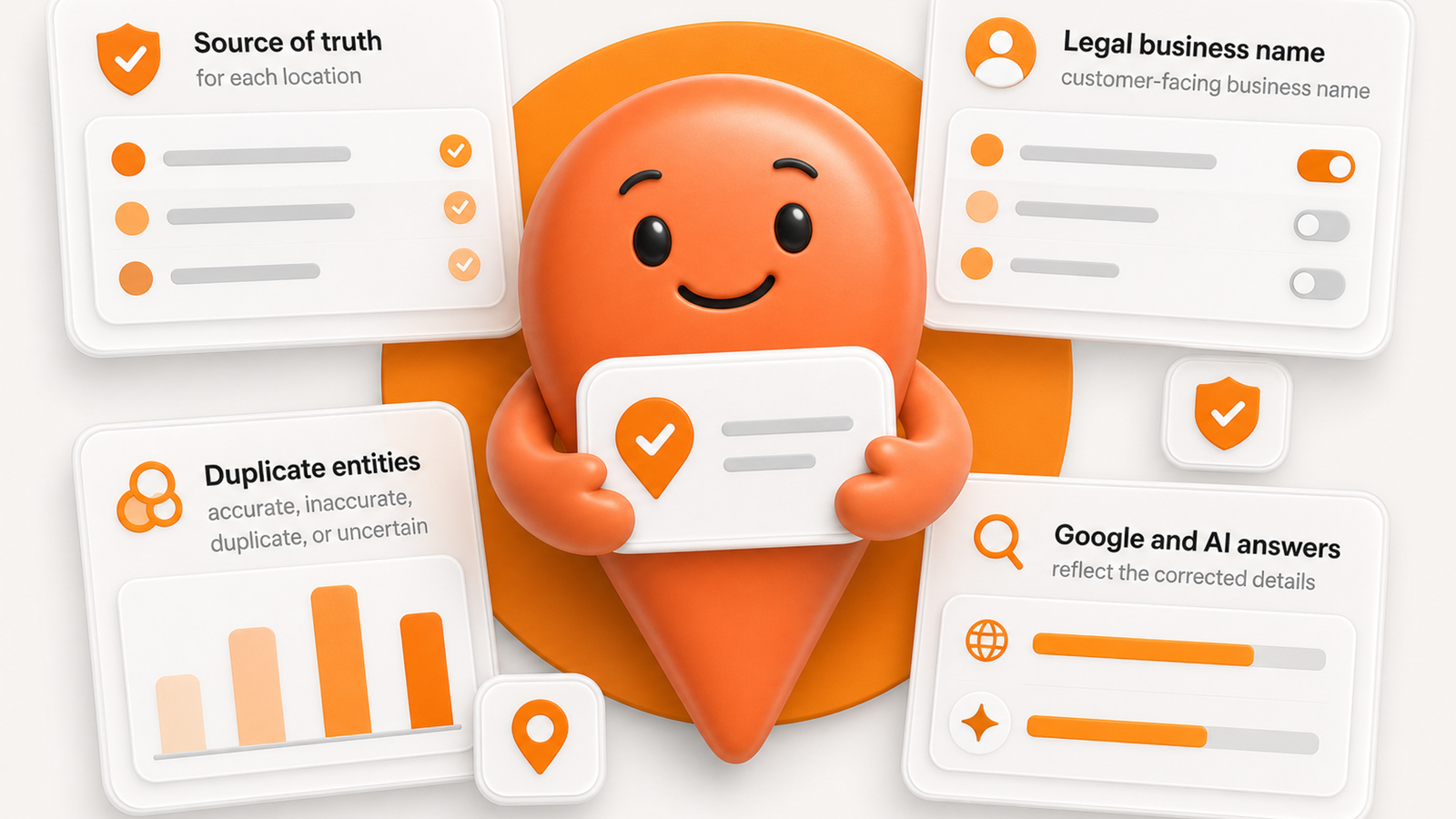
Local citation cleanup for AI search means reconciling important versions of your business facts so search engines, maps, directories, and AI answer tools can identify the same business more clearly.
Direct answer: Start with one approved record for each location, correct your website and major profiles first, resolve true duplicates carefully, and then verify that Google and AI answers reflect the corrected details. Consistent citation data gives customers, search engines, maps, directories, and AI tools clearer business facts to identify and repeat.
Use AI search visibility audits to record individual answers, prompts, markets, and timing, then monitor repeated results for changes in how your business facts appear.
What local citation cleanup means for AI search
A local citation is an online mention of business information, usually a name, address, phone number, website, category, or location. Citation cleanup is the process of finding inaccurate, duplicate, outdated, incomplete, or conflicting mentions and bringing them into line with verified business facts.
For AI search, this is best treated as entity reconciliation, not a directory-submission project. The aim is to make it easier for systems to distinguish your company from a former location, a similarly named business, an individual practitioner, or a wrongly connected map listing.
A correct listing alone does not cause an AI assistant to recommend a business. Generated local answers may draw on profiles, websites, reviews, directories, local sources, and search results. But conflicting facts create unnecessary uncertainty when a customer or system is trying to determine who you are, where you operate, and whether your details are current.
RankSimply treats citation work as part of a wider local visibility process. Citation consistency works alongside accurate Google Business Profile details, location pages, reviews, business schema, relevant third-party sources, and evidence of which businesses appear for the local questions customers ask.
Why inconsistent business facts create entity confusion
Entity confusion happens when online sources appear to describe multiple versions of the same business—or incorrectly combine your business with another one.
A business may have an old address on a directory, a former name on a map profile, a tracking number on one listing, and different operating hours on its website. A customer might encounter a bad listing. A search or AI system may also have less clarity about which source represents the current business.
Citation cleanup reduces conflicting business information and makes essential facts easier to verify across customer-facing sources.
Common citation conflicts to find
Look for conflicts in these fields before adding new listings:
- Legal business name and customer-facing business name
- Street address, suite number, postal code, and map pin
- Primary phone number
- Main website URL and individual location URL
- Primary and secondary categories
- Regular and holiday hours
- Service area, where applicable
- Appointment or booking URL
- Social profile URLs
- Services, attributes, accessibility details, and payment information where a platform supports them
- Former names, former domains, former phone numbers, and closed locations
A difference is not always an error. For example, a legal company name may differ from the public trading name. Define which version belongs in each context and use it consistently.
Start with a single source of truth for each location
Do not begin editing listings from memory. Build a source-of-truth worksheet for every active location, have the appropriate internal owner approve it, and retain evidence for important changes such as relocations and rebrands.
For a single-location business, one worksheet may be enough. For multi-location brands, each location needs its own record. A head-office address, regional phone number, and local landing page should not be copied blindly across every branch.
| Field | Approved value | Source or proof | Owner | Last confirmed |
|---|---|---|---|---|
| Customer-facing name | Registration or brand approval | |||
| Legal name | Registration record | |||
| Address and suite | Lease, utility record, or map verification | |||
| Primary phone | Call-routing approval | |||
| Primary website URL | Website owner | |||
| Location page URL | Website owner | |||
| Categories and services | Operations approval | |||
| Hours and holiday hours | Location manager | |||
| Service area | Operations approval | |||
| Booking URL and social profiles | Marketing owner |
Keep the worksheet accessible to the people responsible for operations, marketing, and customer service. A cleanup effort can quickly become outdated when a location changes hours or moves but nobody updates the record used for future corrections.
Define the canonical version before editing
Choose a preferred format for business names, addresses, phone numbers, and URLs. For example, decide whether a suite appears as “Suite 200” or “Ste 200,” then use that format where the platform allows it.
Do not force a format that conflicts with a platform’s required address fields. Accurate, platform-compliant information comes first.
On the company website, publish approved location details prominently on the relevant location page. If you use business schema, make the visible page content and structured data agree. Schema can express facts in a machine-readable format, but it cannot correct an inaccurate map profile or third-party directory record.
For a broader profile review, see our guide to improving business profiles for AI search.
Audit the listings and profiles that matter first
You do not need to fix every obscure directory before correcting sources customers and search systems are most likely to encounter. Prioritize by customer use, category relevance, the seriousness of the mismatch, and whether the listing is a major source of calls or directions.
| Source group | Cleanup priority | What to check | Typical action |
|---|---|---|---|
| Company website | Highest | Location pages, contact details, schema | Correct and publish approved facts |
| Google Business Profile | Highest | Name, address, category, hours, URL | Update current facts or resolve duplicates |
| Major maps and data sources | High | Address, phone, pin, category | Correct current location identity |
| Major review platforms | High | Core business facts and duplicate pages | Claim and update the accurate profile |
| Vertical directories | Medium to high | Credentials, services, location | Correct where customers search |
| Chambers and associations | Medium | Name, membership, website | Request an update from the publisher |
| Long-tail directories | Low | Severe errors or duplicate records | Fix selectively or document for later |
Start with the company website and Google Business Profile because they are business-controlled sources that should clearly state the current business identity. Then move to major maps, review platforms, and directories that matter in your category or city.
A low-value directory with a minor abbreviation difference is usually less urgent than a major profile that sends callers to a disconnected phone number or points customers to a closed location.
Build an audit tracker, not a loose list of links
Track every listing you review. A cleanup tracker prevents duplicate work, makes handoffs possible, and creates a record of submitted corrections.
| Listing URL | Source group | Claimed? | Exact mismatch | Correction owner | Submitted | Verified |
|---|---|---|---|---|---|---|
| Google Business Profile | Yes/No | Date | Pending/Complete | |||
| Map or data source | Yes/No | Date | Pending/Complete | |||
| Review platform | Yes/No | Date | Pending/Complete | |||
| Industry directory | Yes/No | Date | Pending/Complete |
Record screenshots, confirmation emails, case numbers, and supporting documents for high-value corrections. Some publishers require manual review, proof of ownership, or a request through an account holder.
A step-by-step local citation cleanup workflow
1. Inventory active, former, and duplicate entities
Search for the business name, old names, address variants, phone numbers, former domains, and individual practitioner names. Include branded searches for each location.
Mark each result as accurate, inaccurate, duplicate, or uncertain. Do not assume two similar records are duplicates until you compare their addresses, phone numbers, URLs, reviews, and history.
2. Confirm the source of truth
Approve the worksheet before making external changes. For locations with a recent move, merger, name change, or ownership change, gather the documentation publishers may request.
This avoids correcting listings to match an outdated website or old internal spreadsheet.
3. Correct first-party assets first
Update the website, location pages, structured data where relevant, and Google Business Profile before working through third-party listings. These sources should provide a clear current reference when directory publishers review changes.
4. Fix high-priority third-party sources
Claim accounts where possible, submit corrections, and document the submission date. For sources you do not control, use the publisher’s official correction process and retain the request record.
Do not create a new profile simply because an existing listing contains a mistake. A new profile can create a second entity that is harder to resolve later.
5. Resolve duplicates through merge, move, or closure requests
A duplicate is not automatically safe to delete. It may contain reviews, links, or an indexed record that should be merged, marked as moved, or marked permanently closed rather than removed.
First determine which listing is authoritative and current. Then use the platform’s available duplicate, merge, move, or closure process. For Google Business Profiles, review the current profile status and use Google’s applicable duplicate, relocation, or closure workflow rather than creating a competing replacement profile.
Preserve listing URLs, screenshots, and supporting evidence until the outcome is confirmed.
6. Recheck the sources and search surfaces
Return to each corrected listing after an appropriate review period. Confirm the visible facts, map placement, website destination, and duplicate status. Update the tracker rather than assuming a submitted edit was accepted.
How to handle duplicates, relocations, rebrands, and practitioner listings
Multi-location brands
Give every physical location a distinct record, local phone number where applicable, location page, operating hours, and map profile. Do not use a generic corporate page as the destination for every branch when location-specific pages are available.
Keep brand-wide facts consistent, but do not erase real differences between locations. Services, hours, accessibility details, appointment links, and local categories can vary.
Individual practitioners
Practitioner listings need a deliberate policy. A practitioner working at one office may be a legitimate separate entity, while an outdated practitioner profile may create confusion after they leave.
Confirm whether the practitioner has an independent public-facing practice, separate contact details, and a valid reason to maintain a distinct listing. If not, request an update or closure through the relevant platform rather than leaving stale profiles connected to the business.
Moved businesses
For a move, update the approved address across the website and primary profiles first. Where a platform provides a moved-location process, use it instead of deleting the old record without review.
A deleted old listing can leave customers without useful context, while a poorly handled replacement listing can create duplicate records. Document the old and new addresses in the tracker until the transition is resolved.
Renamed businesses
A rebrand needs more than a new logo. Update the customer-facing name, website references, profile names, social accounts, directory records, and schema where relevant. Preserve a brief explanation on the website if customers may still search for the former name.
Avoid presenting a name change as a new company if the underlying location and business identity remain the same. That can split information across two entities.
Closed locations
Mark permanently closed locations correctly on major profiles and update location finders, local pages, appointment links, and directory entries. Leaving a closed branch live can send customers to the wrong place and create conflicting information about active locations.
Service-area businesses
A service-area business should use the address-display settings supported by each platform. Do not publish an address where customers cannot visit if doing so conflicts with the platform’s rules or the business reality. Keep the actual service territory, contact method, hours, and booking path clear on the website and profiles.
Which citation problems require manual escalation
Some listing issues are not simple edits. Escalate cases where a platform has connected your listing to another business, a duplicate holds significant reviews, an old address remains indexed, a profile was created or claimed by someone else, or a map pin places the business at the wrong location.
Provide concise evidence: current business name, correct address, phone number, website, screenshots, account details, and supporting documentation where requested. Keep the case number in the tracker and avoid repeated, conflicting submissions from different staff members.
Validate cleanup across Google and AI search tools
Validation should check both facts and visibility context. Citation cleanup can reduce ambiguity, but it should be reviewed alongside the other information that shapes local discovery.
Use this post-cleanup check:
- Run branded searches for the current name, former name, address, and primary phone number.
- Check the local pack and map result for the business name, location, category, hours, website, and phone number.
- Confirm important directory pages display approved data and that duplicate records are merged, closed, moved, or otherwise resolved.
- Test relevant structured data on the location page when schema is used, and make sure visible on-page facts match it.
- Test representative prompts about business details and local services, such as “What are the hours for [business name] in [city]?” or “Who provides [service] near [area]?”
- Record the answer, displayed sources where available, competitors mentioned, market, date, and prompt wording.
Check repeated AI responses across relevant queries, locations, platforms, and dates. Record whether key facts are correct and whether the business is easier to identify across the local search surface.
RankSimply monitors selected prompts across ChatGPT, Claude, Gemini, Perplexity, Grok, Copilot, and Google AI Overviews, with platforms selected during onboarding. It records observed AI answers and sources alongside local-pack context, then helps coordinate citation, profile, review, schema, competitor, and content improvements. Learn more about the AI Overview tracker.
Citation cleanup vs. citation building: what comes first?
Fix inaccurate high-priority citations before adding new ones. Building more listings while core records conflict can spread incorrect business facts further.
| Task | Best use | First priority? | Expected outcome |
|---|---|---|---|
| Citation cleanup | Wrong, duplicate, old, or conflicting records | Yes | Clearer business identity |
| Citation building | Missing relevant, accurate listings | After cleanup | Broader valid presence |
| Schema work | On-site facts need machine-readable support | Alongside cleanup | Clearer on-site facts |
| Review work | Customers need current proof and responses | Ongoing | Better customer-facing evidence |
| Location-page work | Local services or locations are poorly explained | Ongoing | Clearer local context on site |
Citation cleanup is not more important than every other local-search task. It is a correction task. A business with accurate listings but thin location pages, weak reviews, unclear categories, or poor service information may still be absent from local recommendations. Strong conventional local SEO also does not ensure that every AI answer will include the business.
FAQ
Do local citations still matter for AI search?
Local citations serve as supporting entity evidence. Consistent business facts across authoritative profiles, maps, websites, and relevant directories reduce confusion about who the business is and where it operates.
Can incorrect citations make an AI assistant show the wrong address or phone number?
Incorrect citations can leave conflicting business information online, creating a risk that customers or systems encounter outdated details. Correct the website and major profiles first, then document and resolve important third-party mismatches.
Should I fix every directory listing?
No. Start with the company website, Google Business Profile, major maps, major review platforms, relevant vertical directories, and trusted local organizations. Fix low-value directories when they contain serious errors, duplicates, or customer-facing problems, but do not let them delay higher-priority corrections.
How long does local citation cleanup take to appear in search results?
Timing varies by platform, verification requirements, publisher review processes, crawl schedules, and whether a duplicate or ownership dispute is involved. Track submitted dates and verify each correction rather than assuming an accepted request has updated everywhere.
What is the best approach for multi-location citation cleanup?
Use a separate approved fact sheet and audit tracker for every location, then prioritize profiles and directories that affect each market. Ongoing monitoring helps multi-location teams catch new conflicts caused by moves, holiday hours, staff changes, and duplicate listings.
Clean citations give search systems and customers a clearer version of your business. The next step is to check whether that clarity is appearing where local decisions happen.
RankSimply offers a free AI visibility report with no signup. We can monitor recommendation prompts that matter to your markets and coordinate citation, profile, review, schema, competitor, and content work around verified gaps. Learn more about our generative engine optimization services.