How Often to Check AI Recommendations
Learn how often to check AI recommendations: use monthly prompt checks, quarterly reviews, and event-triggered monitoring for local visibility.
By RankSimply ·
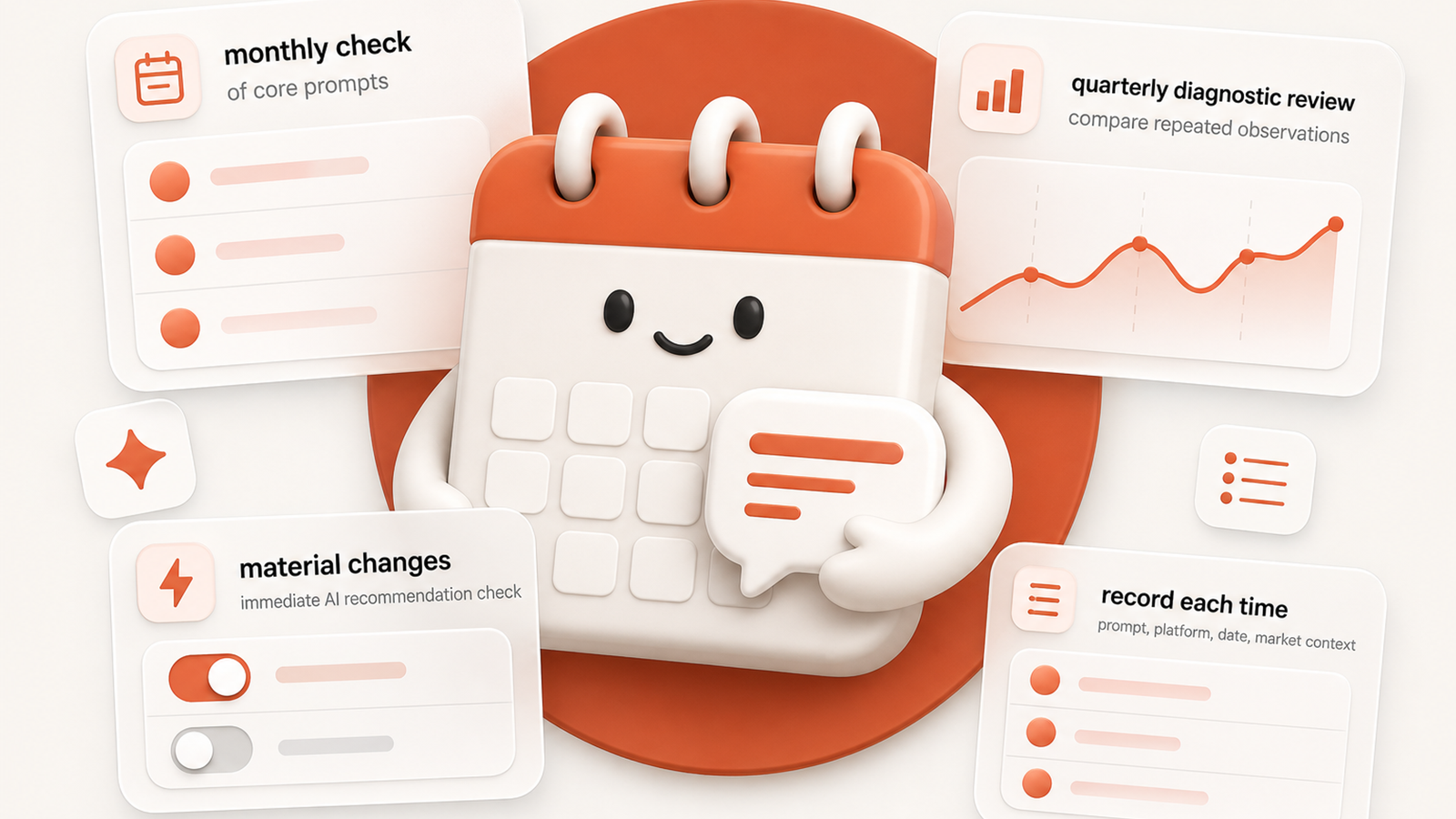
Quick answer: Check a stable set of high-value AI recommendation prompts monthly, complete a deeper quarterly review, and recheck after material business or visibility changes. RankSimply helps local businesses monitor recommendations across AI assistants and Google, then connect the findings to profile, review, citation, schema, competitor, and content work.
How often should you check AI recommendations?
How often to check AI recommendations depends on the stakes, but most local businesses should run a monthly check of core prompts, a quarterly diagnostic review, and an additional check after meaningful changes. Daily checks usually create noise because AI answers can vary by platform, model, prompt wording, time, and user context.
The purpose of monitoring is not to treat one response as a permanent ranking. It is to find repeatable patterns: which businesses appear, how they are described, which sources are cited, and whether your business is absent or inaccurately framed across repeated checks.
Keep two jobs separate:
- Monitor outputs: Record what ChatGPT, Gemini, Claude, Perplexity, Copilot, Grok, and Google AI features show for the agreed prompts and market context.
- Improve inputs: Verify and strengthen the evidence behind your business, including profiles, reviews, citations, website content, schema, and third-party references.
A changed answer is a signal to investigate, not proof that a single profile edit or review caused the change. The same restraint applies when your business appears: one favorable answer does not establish durable visibility.
Which AI recommendation prompts should you monitor every month?
A local business should monitor a small, stable prompt set that reflects real buying decisions rather than repeatedly testing random wording. Start with 10 to 20 prompts for one location or service area, then expand only when each prompt has a clear service, market, or customer-intent purpose.
Use the same wording and location context each month so the record is comparable. You can maintain a separate set for each market, but do not combine results from different locations into one scorecard.
| Prompt intent | Example prompt pattern | What it can reveal |
|---|---|---|
| Service | “Who provides [service] in [location]?” | Core category recommendations |
| Location | “Where can I find [service] in [location]?” | Market-specific inclusion |
| Comparison | “What are the best options for [service] in [location]?” | Competitive shortlist placement |
| Problem | “Who can help with [customer problem] in [location]?” | Whether your service matches a need |
| Best-for | “Which [business type] is best for [buyer need] in [location]?” | Whether your differentiators are understood |
Build prompts around services you actually provide and claims you can support. For example, a service prompt can test category visibility, while a best-for prompt can test whether assistants connect your documented strengths to a buyer need.
Run the core set across the platforms relevant to your audience: ChatGPT, Gemini, Claude, Perplexity, Copilot, Grok, and Google AI features when they appear for the query. A platform may return a different answer, cite different sources, or provide no recommendation at all. Record that outcome rather than forcing platforms into a single ranking.
For a broader starting point, see the local business AI search checklist before finalizing your first prompt set.
When should you run a deeper quarterly AI visibility review?
Run a quarterly AI visibility review to compare repeated observations, identify persistent recommendation gaps, and decide which local visibility inputs deserve attention next. The review should examine patterns across prompts and platforms, not react to one answer that changed from the prior month.
A useful quarterly review asks four questions:
- Where are we consistently included, excluded, or misdescribed? Look for patterns across similar service and location prompts.
- Who is repeatedly recommended instead? Note competitors named, the attributes assigned to them, and the sources that appear alongside them.
- What evidence supports or contradicts our own business facts? Review your profile, website, reviews, citations, service pages, and structured data for accuracy and consistency.
- What changed since the last review? Compare new or updated pages, review themes, competitor activity, profile changes, and source citations.
The goal is a short, prioritized work list. A business with inconsistent hours or services across listings may need fact corrections before publishing another article. A business repeatedly omitted for a specific service may need clearer, accurate coverage of that service on its website and profiles.
RankSimply’s monitoring can keep observed AI answers, citations, named competitors, and Google local-search context together, making it easier to move from an answer change to a specific diagnostic question. Its work is not limited to tracking: profile, review, citation, schema, competitor, and content improvements can be coordinated after the evidence is reviewed.
What changes should trigger an immediate AI recommendation check?
Run an immediate AI recommendation check after a material change that affects what customers or search systems can verify about your business. Check the same agreed prompt set before and after the change when possible, then allow enough time for public information to be available before treating the result as meaningful.
Event-triggered checks are appropriate after:
- Opening, moving, closing, or materially changing a location
- Adding, removing, or substantially changing a service
- Updating important business-profile facts, categories, hours, services, or website destinations
- A major shift in review volume, review themes, or public customer feedback
- A competitor launch, expansion, rebrand, or prominent local campaign
- A significant press mention or third-party feature
- A major website redesign, service-page update, content launch, schema update, or domain change
These checks do not require a full quarterly audit. Start by confirming whether the assistant can still state your core business facts correctly. Then inspect whether the same competitors and cited sources are appearing for the same prompts.
For profile changes, pair the check with Google Business Profile optimization so the facts customers see in Google and the facts described elsewhere remain aligned.
How does monitoring frequency change for local businesses, multi-location brands, and competitive markets?
Monitoring frequency should rise when recommendation visibility has greater revenue impact, competitor activity is high, or many locations require separate fact checks. A low-competition business may need only a monthly core check, while a multi-location brand or an actively changing business needs a tighter operating schedule.
| Business situation | Core prompt checks | Deep review | Event-triggered checks |
|---|---|---|---|
| Low-competition local business | Monthly | Quarterly | After material changes |
| Competitive local category | Monthly, with priority prompt checks between reviews | Quarterly | After competitor or major visibility changes |
| Multi-location business | Monthly by priority market | Quarterly by market or region | After any location-level change |
| Active marketing or operational changes | Monthly plus change-related checks | Quarterly | Immediately after each material change |
Do not increase frequency simply because a tool makes more checks possible. Increase it when the extra observations will lead to a decision: correcting facts, investigating a competitor pattern, updating an approved service page, or confirming the impact of a meaningful business change.
For multi-location brands, governance matters as much as cadence. Use a shared master prompt library, define which markets each prompt applies to, and assign an owner for business facts at every location. A prompt about one branch should not be treated as evidence about the entire brand.
What should you record each time you check an AI recommendation?
Record the prompt, platform, date, market context, answer framing, competitors, sources, and next action every time you check an AI recommendation. A structured log turns scattered screenshots and impressions into comparable observations that a marketing, operations, or location team can review over time.
Your recommendation-check log should include:
| Field | What to capture |
|---|---|
| Prompt | Exact wording used |
| Platform | ChatGPT, Gemini, Claude, Perplexity, Copilot, Grok, or Google |
| Date | Date and time of the check |
| Location context | Market, service area, or location named in the prompt |
| Brand inclusion | Included, omitted, cited only, or inaccurately described |
| Position or framing | First named, one of several options, qualified mention, or negative context |
| Competitors named | Every business mentioned in the response |
| Cited sources | URLs, publications, directories, or profile sources surfaced |
| Follow-up action | No action, fact check, competitive review, or approved improvement task |
Also save the full response or a screenshot where your process allows it. A short label such as “included” cannot explain whether the assistant positioned your business as a specialist, a general option, a source citation, or an unsuitable choice.
Google deserves its own context fields. When checking Google, record whether an AI Overview appeared, which brands or sources it surfaced, and the related local-pack or organic context. A cited website is not necessarily a business recommendation, so keep those outcomes distinct.
How can you tell whether a recommendation change actually matters?
A recommendation change matters when it repeats across agreed prompts or platforms, introduces a material business-fact error, or coincides with a clear shift in competitor or source patterns. A one-off difference in a single AI response is usually a reason to log and watch, not an automatic reason to change your marketing plan.
Use this simple decision rule:
- Log and monitor: One changed response, no factual error, and no repeated pattern.
- Investigate: Your business is repeatedly omitted, a competitor repeatedly gains prominence, or a recurring source pattern changes.
- Correct promptly: An assistant describes your location, hours, services, eligibility, or other core facts incorrectly and you can identify public information that needs correction.
When an important pattern appears, investigate in this order:
- Verify business facts. Check names, addresses, phone numbers, hours, categories, services, website destinations, and location details.
- Inspect reviews and profiles. Look for recent review themes, incomplete profile fields, outdated images, inaccurate attributes, or weak service descriptions.
- Check citations and schema. Compare key third-party listings with the website and confirm that structured data matches visible page content.
- Compare competitor evidence. Review the businesses repeatedly recommended, their public profiles, cited sources, service coverage, and local proof.
- Address content gaps. Create or improve pages only where a real customer question, missing service explanation, or weak local evidence supports the work.
This sequence avoids a common mistake: publishing content before fixing basic facts. It also keeps teams from claiming that any one activity will force an AI assistant to recommend them.
Frequently asked questions
Should I check AI recommendations every day?
Most local businesses do not need to check AI recommendations every day. Daily outputs can fluctuate because platforms, models, prompt wording, timing, and context can differ. A monthly check of a stable core prompt set, plus quarterly analysis and event-triggered checks, provides a clearer record without overreacting to normal variation.
Do ChatGPT, Gemini, Perplexity, and Google show the same business recommendations?
No. ChatGPT, Gemini, Perplexity, Google AI features, and other assistants can return different business recommendations or cite different sources for the same question. Treat each platform as a separate observation, record the exact prompt and market context, and compare repeated patterns rather than expecting a universal result.
What should I do if an AI tool recommends a competitor instead of my business?
First, record the answer, named competitors, cited sources, prompt wording, platform, and location context. Then verify your business facts, profiles, reviews, citations, schema, and service content before comparing the public evidence behind repeatedly recommended competitors. A competitor mention is a diagnostic clue, not proof that one quick change will alter future answers.
How soon should I recheck after updating my Google Business Profile or website?
Recheck after the updated information is publicly available, but do not treat the first new response as conclusive. Use the same prompt and location context, log the result, and review it again during your next scheduled check. A profile or website update may correct facts without immediately changing every AI response.
How can you maintain a consistent AI recommendation-monitoring workflow?
Maintain a consistent workflow by assigning an owner, preserving a stable prompt set, logging every observation, and reviewing recurring patterns monthly and quarterly. This approach makes AI recommendation monitoring a practical local-visibility process rather than a stream of isolated screenshots.
Start by choosing the locations, services, and buyer questions that matter most. Then use a shared log and a defined follow-up path for facts, profiles, reviews, citations, schema, competitor research, and content. If your team needs help running that loop across AI assistants and Google, generative engine optimization services can connect monitoring findings to approved visibility improvements.