Fix Missing Business AI Citations: A Practical Guide
Fix missing business AI citations by finding conflicting profiles, weak proof, outdated directories, schema gaps, and incomplete service pages.
By RankSimply ·
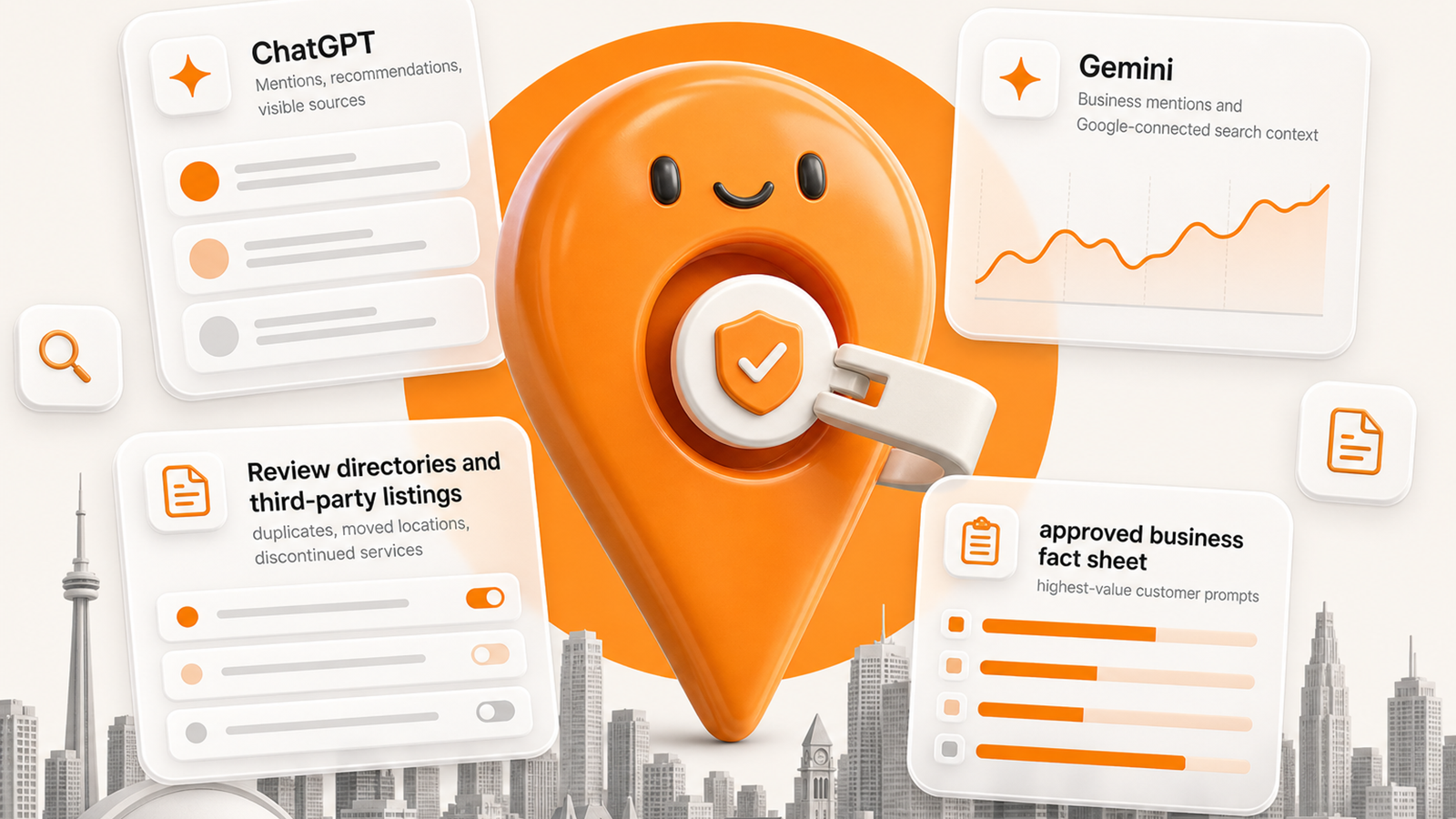
Quick answer: Fix missing business AI citations by testing the customer questions that matter, identifying whether the gap is a missing mention, recommendation, citation, or incorrect fact, and correcting the public evidence behind it. Track the same prompts after each correction to see whether your business facts, sources, and recommendations improve.
To fix missing business AI citations, do not begin by publishing another generic article. First record whether AI systems omit your business, recommend it without citing a source, cite inaccurate information, or confuse it with another company. Then repair the fact and proof gaps behind that result.
Why Is My Business Missing From AI Citations and Recommendations?
Your business may be missing from AI answers because the available information does not clearly connect your name, location, services, and customer evidence to the question being asked. A complete Google Business Profile matters, but it is only one record among your website, directories, reviews, third-party coverage, and structured data.
An AI citation is a visible link or source reference attached to an AI-generated answer. A business recommendation is different: the answer names your company as an option, whether or not it links to your site.
That creates four distinct problems:
- No citation: The assistant answers the question but does not link to your website or another source about your business.
- No recommendation: The assistant cites sources but does not name your business as a suitable option.
- Incorrect business information: The assistant names your company but gives the wrong hours, services, address, ownership details, or eligibility information.
- Entity confusion: The assistant merges your business with a similarly named company, an old location, a former brand, or a duplicate listing.
Treat these as evidence problems, not content-volume problems. A useful page can support a claim, but it cannot correct an outdated directory listing, an unmanaged profile, or conflicting business details across the web.
How Do You Tell Whether the Problem Is a Missing Citation, a Missing Recommendation, or Incorrect Business Data?
Separate citation presence, recommendation presence, and factual accuracy before making changes. A cited source may not recommend your business, while a recommendation may appear without a visible citation. Each outcome points to a different evidence gap and next step.
Use an audit record for every test:
| Field | What to record |
|---|---|
| Prompt | Exact customer question |
| Platform | AI system or Google search surface |
| Market | Location or service area in the question |
| Result | Mentioned, recommended, cited, omitted, or incorrect |
| Sources | Linked pages, profiles, directories, or publications shown |
| Competitor pattern | Businesses or source types appearing instead |
| Next action | Profile, directory, review, schema, page, or source correction |
This distinction prevents a common mistake: editing your homepage because you want a citation when the real issue is an old directory listing with the wrong category or a service page that never answers the eligibility question in the prompt.
| Symptom | Likely cause | Evidence to inspect | Appropriate next action |
|---|---|---|---|
| Business is omitted everywhere | Identity or discovery gap | Name, address, phone, website, categories | Align owned profiles and core listings |
| Business is named with wrong facts | Stale third-party data | Cited directory or publisher page | Request correction at the source |
| Website is cited but business is not recommended | Missing service or proof detail | Service pages, reviews, comparison pages | Add clear service, fit, and proof information |
| Competitor is recommended repeatedly | Competitor has stronger visible evidence for the prompt | Their cited source types and your missing evidence | Close the specific profile, review, directory, or content gap |
| Business is confused with another company | Ambiguous entity information | Similar names, duplicates, old locations | Clarify identity and resolve duplicate records |
Which AI Platforms Should You Check Before You Change Anything?
Check ChatGPT, Gemini, Claude, Perplexity, Copilot, Grok, and Google using the same prompt wording, market details, and recording method. One platform’s answer does not diagnose the others. Record each platform’s response separately so you can see where your business is omitted, misrepresented, recommended, or cited.
Build prompts from questions customers ask when choosing a provider. Include service, location, comparison, eligibility, and trust questions rather than searching only for your business name.
Choose the right monitoring approach
| Approach | Identifies missing AI citations or recommendations | Identifies local-profile and listing issues | When to use it |
|---|---|---|---|
| AI recommendation monitoring | Yes. It records whether a business is mentioned, recommended, or supported by visible sources for selected prompts. | It can reveal a likely evidence gap, but does not by itself correct profile data. | Use it to establish an AI-answer baseline and identify the sources or competitors appearing instead. |
| Traditional local SEO tooling | It can show local-pack and organic visibility, but does not document AI-answer citations across assistants. | Yes. It helps teams review profiles, listings, rankings, and citation consistency. | Use it when the primary question is whether Maps, profiles, directories, or local search results contain inaccurate or incomplete data. |
| RankSimply | Yes. RankSimply monitors selected prompts across ChatGPT, Claude, Gemini, Perplexity, Grok, Copilot, and Google AI Overviews. It separates source-only citations from business recommendations. | Yes. It connects AI findings with Google Business Profile signals, reviews, citations, schema, local-pack context, competitor research, and content gaps. | Use it when AI-answer monitoring and local visibility work need one coordinated remediation plan. |
Coordinated remediation is warranted when the same market has both an AI-answer gap and conflicting or incomplete local evidence. For example, an assistant may cite a directory with an outdated phone number while your Google Business Profile contains the correct number. The work is to correct the cited directory, confirm consistent facts across major records, and rerun the same prompt.
Use a representative prompt set
Use a focused set of prompts that cover decisions customers actually make. Include questions such as:
- “Who provides [service] in [location]?”
- “Which [business category] should I consider for [specific need]?”
- “Is [business name] open on [day]?”
- “Does [business name] offer [service] in [area]?”
- “What does [service] cost from [business name]?”
- “Which provider is a good fit for [eligibility or use case]?”
- “Compare [your business] with alternatives for [service].”
Run the same wording for each platform during a review cycle. Record the full answer, visible sources, market, date, and any result that requires verification.
Keep a platform-specific monitoring log
| Platform | Check for | Record separately |
|---|---|---|
| ChatGPT | Mentions, recommendations, visible sources | Business facts and cited domains |
| Gemini | Business mentions and Google-connected search context | AI result, local visibility, sources |
| Claude | Mention and factual accuracy | Whether citations are displayed |
| Perplexity | Sources and recommendation wording | Cited pages and source quality |
| Copilot | Business facts and linked references | Mention, citations, and query context |
| Grok | Mentions and factual details | Sources shown and result wording |
| AI Overviews, local pack, organic results | Brands, sources, and local context |
Google needs its own record because a customer may see an AI Overview, local pack, Business Profile, organic result, or a combination. Track Google AI Overviews alongside local-search context so the generated result is not evaluated in isolation.
What Evidence Does an AI System Need to Recognize and Recommend a Local Business?
AI systems need clear identity facts, specific service information, and credible supporting evidence that connects the business to the customer question. The practical goal is one verifiable business record across owned pages, profiles, reviews, directories, and relevant third-party sources.
Start with identity consistency. Confirm that these details match wherever your business controls or can correct them:
- Business name, including punctuation and legal or trading-name differences
- Street address, suite number, phone number, and website
- Operating areas and location-specific contact details
- Primary and secondary categories
- Hours, holiday hours, and appointment requirements
- Services, exclusions, eligibility rules, and pricing approach
- Ownership or franchise details where customers need that distinction
- Profile ownership and administrator access
A Google Business Profile can be complete while directories, social profiles, booking tools, professional listings, or old location pages still contradict it.
Reviews provide customer evidence about the services, locations, and experiences associated with your business. Request reviews after genuine visits or jobs, respond accurately, and use recurring customer questions to improve profiles and service pages. Check whether new reviews describe priority services and locations, then record those topics in your AI monitoring log.
Structured data helps machines read the same business facts that people see. Add LocalBusiness schema where it fits, plus relevant organization or service markup, and keep it aligned with visible page content. Schema should confirm clear on-page information rather than introduce unsupported claims, locations, services, or ratings.
How Do You Audit Your Business Profiles, Reviews, Directories, Schema, and Website for Conflicting Signals?
Audit every place that represents your business against one approved fact sheet. Prioritize conflicts appearing in AI citations, customer-facing search results, or important directories. Each correction should have an owner, source URL, status, and retest date.
Create an approved fact sheet first. Include the exact business name, address, phone number, website URL, hours, categories, operating areas, service list, ownership details, and the pages supporting each claim.
Review owned profiles and access
Confirm that your team owns and can edit the major profiles customers encounter. Check profile URLs, categories, service menus, links, photos, hours, and business descriptions against the fact sheet.
Do not leave former staff, agencies, or unknown accounts as the only administrators of important profiles. A correct fact cannot be corrected quickly if nobody can edit the listing.
Review directories and third-party listings
Search for current and old versions of your business name, address, phone number, website, and brand names. Look for duplicates, moved locations, discontinued services, stale hours, wrong categories, and broken website links.
If an AI answer cites a directory, inspect the exact cited listing before editing your own website. The third-party page may be the direct source of the bad claim. Save the URL and screenshot, submit a correction through the publisher’s process, and record the request.
Review website proof and schema together
For each location and priority service, check whether the visible page answers basic customer questions:
- What service is offered?
- Which location or operating area is relevant?
- Who is it for, and who is not eligible?
- What does the process involve?
- Is pricing available, estimated, or quote-based?
- What proof supports the claim?
- How can a customer contact the right location or team?
Then compare the page to its schema. The business name, address, phone number, hours, service information, and URLs should agree. Use this local business AI search checklist before creating new pages.
What Should You Fix First When Your Business Is Absent From AI Answers?
Fix the clearest high-impact conflict first: inaccurate identity information, an outdated cited source, or a missing page that answers a high-value customer question. This approach focuses effort on the evidence customers and AI systems encounter instead of broad content production.
Use this order when resources are limited:
- Correct identity conflicts. Resolve wrong names, addresses, phone numbers, websites, hours, duplicate listings, and ownership confusion.
- Correct the sources already appearing. If an AI answer links to a directory, publisher, or profile with wrong information, repair that record first.
- Complete priority profiles. Confirm categories, service details, operating areas, contact information, and profile ownership.
- Improve review evidence. Build a consistent request and response process tied to real customer interactions.
- Repair schema and page alignment. Make visible pages and structured data say the same thing.
- Add missing decision-stage proof. Publish a service, location, eligibility, pricing, or process page when it answers a customer question that existing pages do not cover.
- Retest the same prompt cohort. Record changes in mentions, recommendations, factual accuracy, and cited sources.
Each correction gives customers and AI systems a clearer record to verify. Check the result by comparing the original and updated source, then rerunning the same prompt set and recording changes in business facts, citations, and recommendations.
For multi-location operators, complete this sequence one location at a time. Shared brand pages cannot replace location-specific addresses, service availability, profile ownership, reviews, and local proof.
How Do You Improve Your Website So AI Systems Can Verify Specific Services, Locations, and Claims?
Improve your website by making each priority claim easy to locate, specific to the relevant location or service, and supported by visible evidence. A page should answer the customer decision behind the prompt rather than repeat a broad marketing statement across every location.
A strong location or service page identifies the business, service, location or operating area, customer fit, process, and contact path. If you discuss pricing, availability, qualifications, or outcomes, explain the conditions that shape those claims.
Publish pages for distinct customer needs
Create a new page when it has a distinct job. Examples include a location page with local contact details, a service page explaining a specific offering, or an eligibility page that answers a frequent qualification question.
Do not create near-identical pages for every service area. Thin area pages with swapped place names make it harder for customers to find useful information and do not resolve an evidence gap. Build a separate page when you can add location-specific facts, service availability, staff or facility details, customer guidance, or other meaningful proof.
Make claims inspectable
Replace vague statements such as “best service” or “serving everyone” with verifiable details. State the services you offer, where you offer them, what is included, who qualifies, and how a customer can confirm fit.
Add supporting material where appropriate: a clear process, current FAQs, staff credentials where relevant, documented policies, case examples you are permitted to publish, and reviews from genuine customers. Keep every item accurate and current.
Use generative engine optimization for local business evidence when you need a coordinated plan for profiles, citations, reviews, schema, competitor research, and content rather than a page-by-page content project.
When Should You Correct a Third-Party Source Instead of Editing Your Own Site?
Correct a third-party source when it contains the inaccurate fact, appears in the AI answer, ranks for your business, or is likely to influence a customer decision. Editing your own site cannot replace a stale directory, publisher profile, or review-platform listing that continues to publish conflicting information.
Start with the exact source shown in the AI response. Verify whether it is wrong, incomplete, outdated, or referring to a different business. Then use the publisher’s correction process and document the request date, proof supplied, response, and live status.
Prioritize third-party corrections when they involve:
- Wrong address, phone number, website, or hours
- A closed or moved location
- Incorrect business category or service availability
- A duplicate or merged listing
- A former owner, old brand, or confused entity
- Regulated credentials or eligibility information that is incorrect
After the correction is live, rerun the same question set and inspect whether the source remains visible and whether the business facts are accurate. Keep the third-party correction in your log so you can connect the correction to later changes in citations or recommendations.
How Can You Monitor AI Citation Recovery Without Chasing Random Results?
Monitor recovery with a fixed set of prompts, platforms, markets, and review dates. Measure changes in mention presence, recommendation presence, factual accuracy, source quality, query coverage, and qualified referral outcomes. This creates a record of whether the business evidence is becoming clearer for priority customer questions.
Set a baseline before changes. After each material update, record the live correction and rerun the same prompt cohort on your scheduled review dates. Note profile edits, directory corrections, new reviews, page updates, and meaningful competitor changes beside the results.
Use separate measures for separate questions:
| Measure | What it answers |
|---|---|
| Mention presence | Does the business appear at all? |
| Recommendation presence | Is the business presented as an option for the customer need? |
| Factual accuracy | Are key facts correct in the answer? |
| Cited source quality | Are visible sources accurate, current, and relevant? |
| Query coverage | How many priority prompts produce a useful result? |
| Qualified referral outcomes | Do tagged visits, calls, forms, or booked conversations follow? |
Do not treat one improved answer as proof that a single edit caused the change. Compare the captured answers, sources, and fact accuracy across the same prompt and market before and after each correction.
RankSimply monitors selected prompts across ChatGPT, Claude, Gemini, Perplexity, Grok, Copilot, and Google AI Overviews. It records observed answers, citations, competitor share of voice, and answer sentiment alongside profile, review, citation, schema, competitor, and content work. Learn how a defined monitoring set is measured in the AI visibility score methodology.
Frequently asked questions
Can I force ChatGPT or Google AI to cite my business?
No. You cannot direct ChatGPT, Google AI, or another generative system to cite a specific business. Improve the public evidence behind your business, then compare the same priority prompts over time for changes in accurate mentions, recommendations, and visible sources.
How long does it take for corrected business information to appear in AI answers?
The first milestone is the live correction on the profile, directory, or website that published the wrong information. Record that date, rerun the same monitored prompts on your scheduled review dates, and compare the answer text and cited sources with the original capture.
Do Google Business Profile reviews help my business appear in AI recommendations?
Google Business Profile reviews document customer experiences with specific services and locations. Request them after genuine interactions, reply accurately, and use recurring themes to improve profiles and service pages. Check whether recent reviews and related page updates reflect the services, locations, and customer needs in your priority prompts.
What should I do if an AI cites a directory with outdated information about my business?
Open the exact directory listing, compare it with your approved business fact sheet, and submit a correction to the directory owner. Document the source URL, incorrect field, request date, and live correction. Then retest the same AI prompt and check whether the answer and cited source reflect the updated information.
Should I create separate pages for every service area to improve AI visibility?
No. Create a separate service-area page when it adds useful, location-specific information such as service availability, contact details, local process guidance, staff or facility facts, or other evidence customers need. Near-duplicate pages that only replace a place name do not solve missing business evidence.
What should you do next?
Build one approved business fact sheet and run a baseline across your highest-value customer prompts. RankSimply offers a free AI visibility report with no signup, giving local businesses a starting record of AI recommendations, citations, and the evidence gaps to fix first.