Find a Local Business Through AI
Find a local business through AI with better prompts, platform guidance, and a checklist to verify hours, reviews, credentials, and availability.
By RankSimply ·
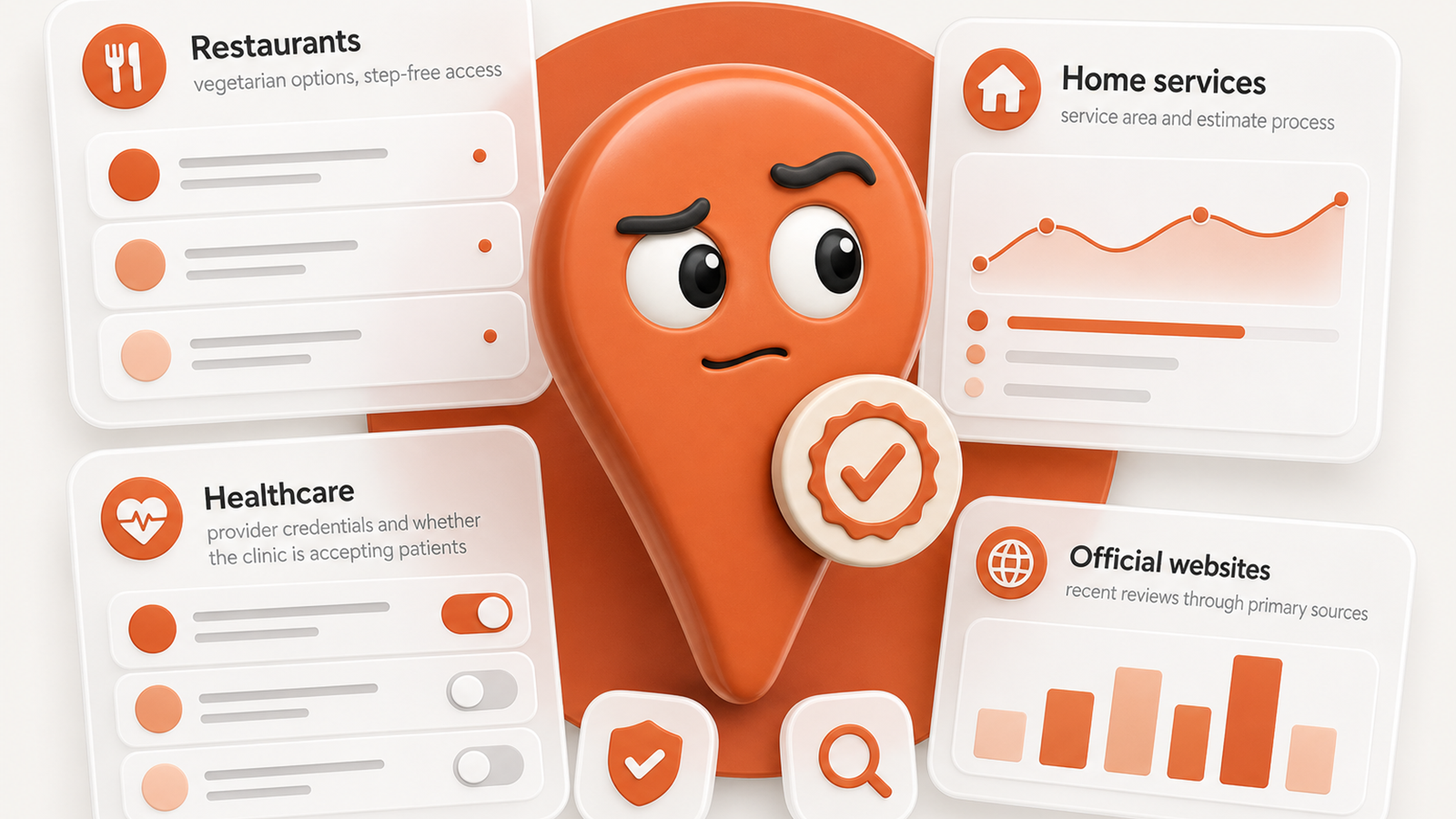
AI can help you find a local business by turning a detailed request into a shortlist. But treat that shortlist as research, not a verified directory listing. Before you visit, book, or buy, confirm the business's address, service area, opening hours, availability, pricing, licensing or credentials where relevant, and recent reviews through primary sources.
A useful local search workflow is simple: ask for a focused set of options, request the reasons and sources behind the suggestions, then verify each finalist yourself. This works whether you start with ChatGPT, Gemini, Claude, Perplexity, Copilot, Grok, or Google.
How to find a local business through AI
Use an AI assistant to narrow a broad local decision into a manageable list. It can be especially useful when your requirements are more specific than “best nearby”—for example, a restaurant with wheelchair access and vegetarian options, or a plumber that serves a particular neighbourhood and can handle a non-emergency repair this week.
Ask for three to five options rather than a single “best” business. Then ask the assistant to explain why each option might fit and provide sources or links when available. A useful answer gives you leads to investigate; it does not prove that a business is operating, qualified, available, or right for your situation.
Follow this workflow:
- Define the service, location, and deadline.
- Add the practical criteria that would rule a business in or out.
- Ask for a short list and supporting links where available.
- Verify each candidate on its own website, map listing, reviews, and by direct contact.
- For regulated or high-stakes work, confirm credentials through the relevant official registry.
AI recommendations and Google Maps serve different parts of this process. An assistant can help translate a detailed need into comparison criteria. A map or business listing can help you inspect location, contact details, hours, and reviews. Use both when the decision matters.
Start with a prompt that includes location, need, and decision criteria
The quality of the local options you receive depends heavily on the details in your prompt. “Find me a dentist near me” leaves too much open to interpretation. A good prompt makes clear what “near” means and what type of provider you actually need.
Include these details when they matter:
- City, neighbourhood, or postal area: Name the area you can realistically travel to, not just the broader metro region.
- Service needed: Be specific about the job, treatment, meal, appointment, or professional matter.
- Time horizon: State whether you need an appointment today, this week, or at a later date.
- Budget: Give a range or ask for options that publish transparent pricing.
- Accessibility needs: Mention mobility access, sensory requirements, parking, transit access, or other needs.
- Language: Ask for businesses that can serve you in your preferred language if that is important.
- Preferred attributes: Examples include evening hours, family ownership, emergency availability, vegan options, a particular service specialty, or experience with a specific property type.
- Sources: Ask for links or sources you can check yourself.
A reusable local-business prompt
Use this structure:
Recommend three to five [type of business] in or near [neighbourhood/city] for [specific need]. I need [timing], and my priorities are [budget, accessibility, language, service requirement, or other criteria]. Explain why each may fit, include source links where available, and separate confirmed details from details I should verify directly.
That last sentence matters. It tells the assistant not to present uncertain details as settled facts.
What each AI platform can and cannot do for local recommendations
Every platform can be a starting point for a local-business search, but none should be treated as the final authority on availability, qualifications, or current business details.
Check the citations, web access, Maps integration, and local results your chosen platform provides, then verify important business details directly.
| Platform | Practical role in local discovery | Ask for | Verify before acting |
|---|---|---|---|
| ChatGPT | Turn detailed needs into a shortlist | Fit rationale and source links | Every business detail |
| Gemini | Explore options from a specific local request | Alternatives and criteria match | Location, hours, availability |
| Perplexity | Research options with supporting sources | Links for each suggestion | Source quality and recency |
| Claude | Refine requirements and compare candidates | A decision checklist | All local facts directly |
| Copilot | Build a shortlist from a clear prompt | Reasons and next checks | Contact details and service area |
| Grok | Generate ideas and comparison questions | Sources and uncertainty notes | Reviews, credentials, pricing |
| Check local listings and search results | Maps, websites, and review context | Current hours, availability, eligibility |
There is no universal “best alternative to Google Maps” for local businesses. If you want help defining your criteria and generating options, an AI assistant can be useful. If you need to inspect nearby locations, contact information, and public reviews, Google search and map listings are often a practical verification step. Use the assistant for discovery and comparison; use first-party sources for confirmation.
Practical prompts for common local-business searches
Different business categories require different proof. A restaurant search may depend on hours and dietary accommodations. A home-service decision may depend on service territory, insurance, schedule, and the scope of work. A healthcare or legal decision requires much closer review of credentials and fit.
Restaurants
Find three restaurants in [neighbourhood] for dinner on [day]. We need vegetarian options, step-free access, a table for [number], and a mid-range budget. Include each restaurant's website and note what I should confirm before booking.
Check the restaurant's current menu, reservation availability, hours, and accessibility details directly. Recent independent reviews can add context, but they are not a substitute for confirming current operations with the business.
Home services
Suggest local plumbers serving [neighbourhood] for a [specific issue]. I need service by [timeframe], prefer businesses that explain their service area and estimate process, and want links to their official websites. List questions I should ask before booking.
Before hiring, confirm that the business serves your address, can handle the job, has availability, and will explain its estimate and payment terms. For work subject to licensing or permit requirements, check the appropriate official local or provincial registry.
Healthcare
Help me identify clinics in [city] that offer [specific service]. I need [language, accessibility, appointment timing, or other need]. Provide official websites and a checklist for confirming provider credentials and whether the clinic is accepting patients.
Do not use AI output as the sole basis for a healthcare decision. Confirm provider credentials, clinic details, referral requirements where applicable, and appointment availability through official sources and direct contact. In an emergency, contact local emergency services rather than relying on an AI recommendation.
Professional services
Recommend local [lawyers/accountants/financial professionals] in [city] who work with [specific situation]. I want businesses that clearly state their practice area or service scope. Give me official websites and questions to ask about fit, fees, and credentials.
For legal, financial, and other regulated professional services, verify credentials and registration with the relevant official regulator. A recommendation can help create a starting list; it cannot establish that a professional is suitable for your facts or currently able to take your matter.
How to verify an AI-recommended local business before you contact it
A polished AI answer can make a recommendation feel certain. It is not. Verify the information that could change your decision before you share personal information, travel to a location, pay a deposit, or sign an agreement.
Local-business verification checklist
- Official website: Confirm the services offered, address, phone number, service area, and current contact method.
- Google Business Profile or map listing: Check location, listed hours, directions, and recent customer activity. Treat hours as worth confirming for time-sensitive visits.
- Recent independent reviews: Read the newest reviews and look for patterns relevant to your need, such as communication, cleanliness, scheduling, or workmanship.
- Direct contact: Call, email, or use the official booking process to confirm availability, pricing approach, and any requirements.
- Professional registries: For regulated work, check the applicable licensing, registration, or disciplinary information through an official registry.
- Written terms: For material purchases or service work, ask for the estimate, scope, cancellation terms, and payment expectations in writing.
Legitimacy is not something an AI assistant can establish on its own. A business may have a real name and web presence while still being unavailable, outside your service area, unsuitable for the job, or inaccurately described in an older source.
Why AI can miss good local businesses or get local details wrong
Depending on the system, its settings, and the information it can access, an AI assistant may summarize business information that is incomplete, outdated, or poorly matched to your request. Local business information changes frequently: a provider moves, changes hours, stops offering a service, changes its booking process, or expands or reduces its service territory.
A good business can also be absent from an answer because its relevant details are hard to find, inconsistent across the web, too general, or not clearly connected to the question asked. A company may be excellent at a service but not explain that service, its location, or its qualifying experience clearly on public pages.
Different tools can recommend different local businesses because they may interpret your request differently or surface different information. That does not automatically mean one answer is wrong. It does mean you should compare the underlying evidence rather than choosing based on the most confident wording.
Ask a locally specific question, request sources when available, and verify the answer before making contact or spending money.
What local businesses can do to be easier for AI to recommend
Customers can only verify what they can find. Local recommendations are more likely to be useful when public business information is current, specific, and consistent across the places customers and AI systems encounter it.
For a local business, that means keeping the basics accurate: name, address, phone number, website, hours, service area, services, and booking or contact details. It also means publishing useful pages that explain what you do, where you work, who you serve, and what a customer can expect.
The supporting signals matter together:
- Business profiles should accurately describe the location, category, hours, services, and customer contact path.
- Reviews should be monitored and answered thoughtfully, especially when they identify a real customer-service issue.
- Citations and directory listings should not conflict on core business details.
- Business schema should reflect visible, current information on the website.
- Service and location pages should answer real questions rather than repeating generic claims.
- Competitor research can reveal which customer questions and local proof points competing businesses make easier to find.
RankSimply is built for the business side of this interaction. It monitors selected prompts across ChatGPT, Claude, Gemini, Perplexity, Grok, Copilot, and Google AI Overviews, then connects what appears in those recommendations to profile, review, citation, schema, competitor, and content work. This makes the information supporting your business easier to find, assess, and keep current.
Local businesses that want to see how they appear in AI-driven recommendations can start with RankSimply's free AI visibility report. For businesses ready to coordinate ongoing monitoring and local visibility work, see AI recommendation monitoring and generative engine optimization services.
Turn AI discovery into a repeatable local search workflow
Use AI to frame the decision, not to skip the decision process. Give the assistant a detailed local prompt, request a short list with sources, and compare the candidates against the criteria that matter to you. Then confirm the details through official websites, listings, reviews, direct contact, and registries where applicable.
That approach makes AI useful without giving it more authority than it has. You get the speed of a tailored starting list while keeping the final choice grounded in current, checkable information.
FAQ
Can AI find businesses near me?
AI can help identify businesses near a city, neighbourhood, or address area when you include that location in your prompt. Use it to generate options and comparison questions, then directly check each business's address, service area, hours, and availability.
What should I include in an AI prompt for local recommendations?
Include the business type, city or neighbourhood, exact service needed, timeframe, budget, accessibility needs, language preferences, and any must-have attributes. Ask for a short list, reasons each option may fit, and links or sources you can verify.
How do I know whether an AI-recommended business is legitimate?
Check the business's official website, Google Business Profile or map listing, recent independent reviews, and direct contact details. For regulated services, verify the provider or business through the appropriate official licensing or professional registry.
Why does an AI assistant recommend different local businesses than Google Maps?
AI assistants and Google Maps may interpret a request and surface information differently. An AI assistant may focus on the written criteria in your prompt, while map results may prioritize nearby listings and location information. Compare the sources behind each result and verify current details directly before deciding.
Can a local business improve its chance of being recommended by AI?
A local business can improve the information available for recommendation by keeping profiles, reviews, citations, website content, and business schema accurate and specific. RankSimply helps businesses monitor AI recommendations and coordinate those local visibility improvements across relevant public information sources.