Best Tool for AI Answer Tracking
Find the best tool for AI answer tracking by comparing platform coverage, location-level prompts, recommendation data, and action workflows.
By RankSimply ·
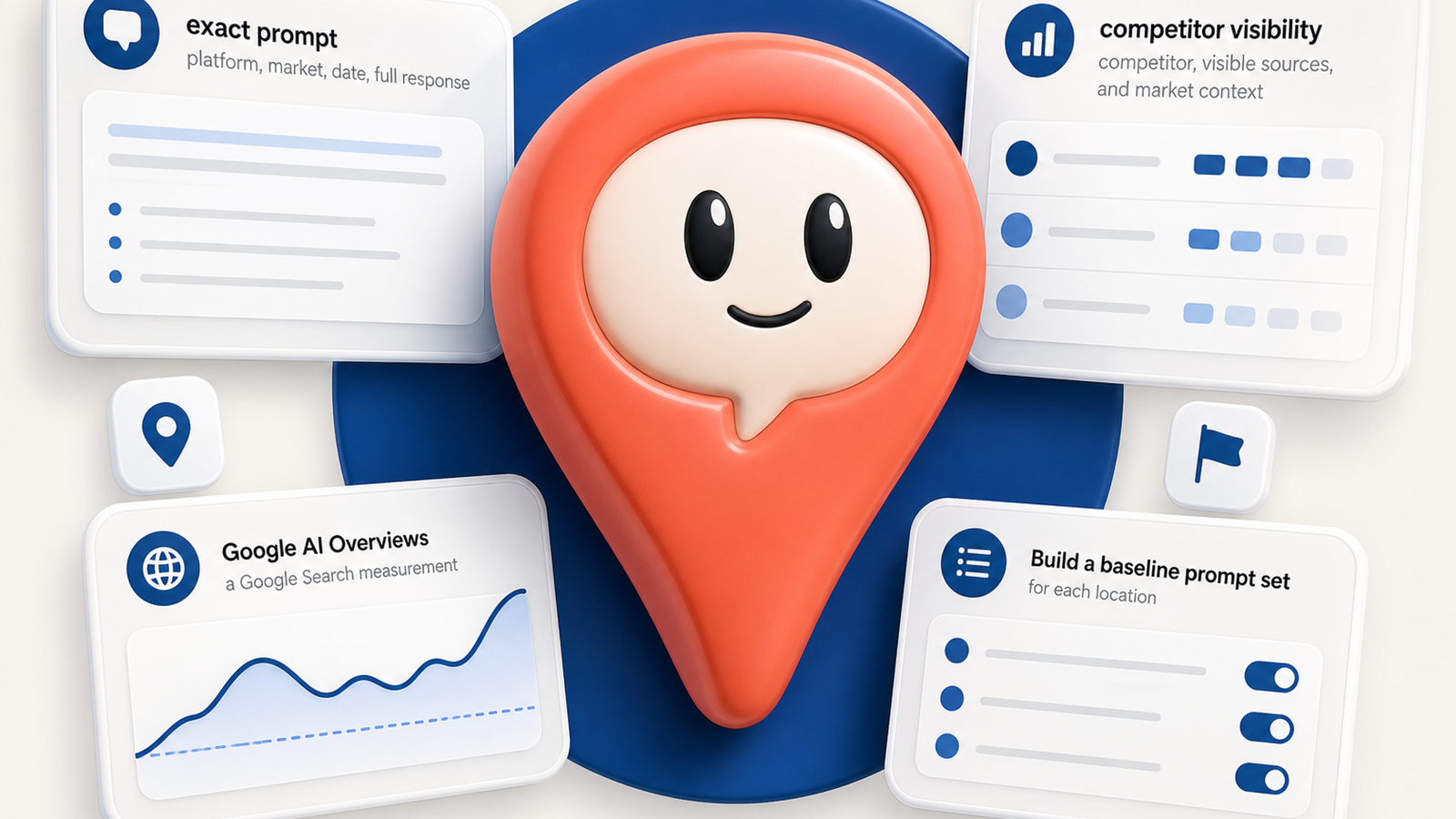
Quick answer: The best tool for AI answer tracking records the platforms, locations, prompts, and recommendation outcomes that matter to your business, then connects missed recommendations to corrective work. RankSimply monitors local-business recommendations across major AI assistants and Google while coordinating profile, review, citation, schema, competitor, and content improvements. Check its value by reviewing the recorded answers, competitors, citations, and follow-up work for the same prompt set over time.
The best tool for AI answer tracking is not a dashboard that reports one blended visibility score. Local businesses need prompt-level evidence: whether they are named, recommended, cited, or omitted for a specific service and market; which competitors appear instead; and what work should follow. A useful platform tracks repeatable checks across the AI tools customers use and keeps the underlying local-search work connected to each finding.
What should you look for in an AI answer tracking tool?
An AI answer tracking tool should record the exact prompt, platform, market, date, full response, named businesses, visible citations, and competitors for each check. For a local business, the deciding factor is whether the tool turns recurring recommendation gaps into prioritized work on business information, reputation, citations, schema, and content.
The category uses overlapping labels, so clarify what a provider actually measures before comparing plans.
| Term | What it measures | What it does not prove |
|---|---|---|
| AI answer tracking | A recorded response to a defined prompt on an AI platform | A fixed search position |
| AI visibility monitoring | How often and where a business appears across a monitored prompt set | Whether every customer sees the same response |
| Prompt tracking | Repeating a documented question over time | Performance for untracked wording |
| Recommendation monitoring | Whether an answer actively suggests a business for a need | That a mere mention is an endorsement |
| Citation tracking | Sources visibly cited or used in an answer where available | That the cited source caused the recommendation |
| Google AI Overview monitoring | Whether an AI Overview appeared and which brands or sources it surfaced | Traditional organic or local-pack rank |
A brand mention and a recommendation should be scored separately. “Business A is located in the area” is a mention. “Business A is a good choice for emergency repair” is a recommendation. Treating both as the same signal inflates visibility reporting and hides the prompts that create commercial intent.
The same distinction applies to citations. A directory or publisher may appear as a source without the business being recommended. Conversely, an assistant may name a business without displaying a source. Your reports should preserve those outcomes rather than collapsing them into a single percentage.
Which AI platforms should a local business monitor?
A local business should monitor the AI platforms that its customers use to research and compare providers, plus Google Search and Maps context. For broad local-discovery coverage, that commonly means ChatGPT, Gemini, Claude, Perplexity, Copilot, Grok, Google AI Overviews, Google local-pack results, and organic Google results as separate surfaces.
Each platform should remain distinct in reporting. A business that appears in a Perplexity response has not necessarily appeared in ChatGPT, Claude, or a Google AI Overview. Google explains that its AI features in Search use the same foundational SEO practices as Search, rather than requiring separate AI-only technical requirements (Google Search Central).
What should local-business prompts look like?
Start with the questions that indicate a buyer is choosing a provider. Use one service, one intended market, and one clear decision context per prompt. Avoid combining multiple services or markets into a single question because the result becomes hard to diagnose.
A starting prompt set can include:
- Service plus market: “Which companies provide drain repair in [market]?”
- Category recommendation: “Who should I contact for a family dentist in [market]?”
- Comparison: “Compare local options for [service] in [market].”
- Emergency service: “Who offers emergency [service] in [market]?”
- Qualification-based research: “Which [service] providers in [market] are known for [specific need]?”
- Branded validation: “What services does [business name] offer in [market]?”
Use the actual city, service area, or postal-code context relevant to the location. Multi-location operators need a separate prompt cohort for each location because one location’s business facts, reviews, competitors, and local search results do not represent another’s.
Why should Google AI Overviews be reported separately?
Google AI Overview monitoring is a Google Search measurement, not a proxy for every answer engine. It should record whether an Overview appeared for a query, which sources and businesses it included, and the local-pack and organic context visible alongside it.
That separation matters because Google results can include organic listings, maps results, local packs, and AI-generated result elements in the same search journey. A tool that only labels a query “visible” leaves the team unable to tell which discovery surface changed or what to investigate next.
How do AI answer trackers differ from traditional rank trackers?
AI answer trackers record generated responses to specific prompts, while traditional rank trackers record a webpage or business listing’s position in a defined search result. Local businesses need both because one answers whether an assistant recommends the business and the other answers how the business appears in Google organic and local results.
A conventional ranking is tied to a specified query, device or location setting, and search-results page at the time it is checked. An AI answer is generated text shaped by prompt wording, requested market, available sources, and product behavior.
A scheduled, documented prompt set creates a record of recommendation movement across valuable prompts and platforms. Preserve each raw answer, compare recurring outcomes, and prioritize the gaps that repeat. The record shows which businesses were named, recommended, cited, or omitted over time.
| Measurement | Core question | Useful output | Follow-up action |
|---|---|---|---|
| Traditional local rank tracking | Where does the listing or page appear in Google? | Local-pack and organic positions by query and market | Improve local relevance and page performance |
| AI answer tracking | Does the assistant name or recommend the business? | Full answer, recommendation status, competitors, citations | Diagnose recurring recommendation gaps |
| AI Overview monitoring | Did Google show an Overview and who or what did it surface? | Overview presence, brands, sources, search context | Review source coverage and search-result context |
| Review and profile monitoring | Are core business facts and reputation signals current? | Review activity, profile issues, fact inconsistencies | Correct records and respond to customers |
Manual searches can help establish an initial baseline, but they do not create an operating record across many prompts, locations, clients, and platforms. A tracking system should store the question and result together so a team can answer: which prompt was lost, to whom, on which platform, and for how long?
Which features matter most for local recommendation queries?
The most useful features for local recommendation queries are platform-level coverage, exact prompt and market controls, recommendation classification, competitor visibility, citation capture, historical evidence, and a clear path from a finding to a task. A local business should not buy on mention counts alone.
Use this evaluation checklist when reviewing a tool or managed service:
- Platform coverage: Can you choose the relevant mix of ChatGPT, Gemini, Claude, Perplexity, Copilot, Grok, and Google AI Overviews rather than receiving an unexplained aggregate?
- Prompt granularity: Can the team track the exact service, comparison, emergency, and category questions customers ask?
- Location granularity: Can each market, service area, or location receive its own prompt set and evidence?
- Recommendation tracking: Does the reporting distinguish between a named brand, an actual recommendation, a competitor recommendation, and a source-only citation?
- Competitor comparison: Can you see which businesses repeatedly replace yours in the same prompt cohort?
- Answer evidence: Can reviewers access the full answer, visible sources, date, and platform rather than only a score?
- Historical trends: Can the team compare recurring checks and identify repeat gaps rather than react to one response?
- Reporting and exports: Can an agency create location- and client-specific reporting that explains what changed and what is next?
- Implementation support: Does the provider help convert findings into profile, review, citation, schema, and content work?
What signals should a tool show after a competitor is recommended?
When a competitor appears instead of your business, the tool should expose the prompt, answer, competitor, visible sources, and market context. The next investigation should compare business categories, service coverage, on-page facts, review themes, citation consistency, schema, and relevant content—not assume one missing keyword caused the outcome.
This is where visibility-only reporting often stops too early. Monitoring identifies the symptom. The operational value comes from assigning the diagnostic work and checking the same prompt again after material improvements are published or corrected.
How should you compare AI answer tracking options for your team?
The choice is usually between a tracking-only process run by your internal team and a managed local recommendation workflow that combines monitoring with corrective work. Compare the option against the work your team must complete after finding a gap: local prompt monitoring, competitor analysis, reporting, and execution.
| Evaluation criterion | Internal tracking process | RankSimply local recommendation workflow | What to verify in a demo |
|---|---|---|---|
| Platform reporting | Your team collects and organizes platform results | Tracks selected prompts across ChatGPT, Claude, Gemini, Perplexity, Grok, Copilot, and Google AI Overviews | See one prompt across the selected platforms |
| Market controls | Your team builds and maintains market-specific prompts | Uses location-specific prompts and evidence for local businesses | Ask how each location is configured |
| Recommendation evidence | Your team classifies raw answers and citations | Exposes observed AI answers and citations, competitor share of voice, and answer sentiment | Open the recorded answer |
| Local SEO follow-through | Your team assigns and completes fixes | Coordinates profile, review, citation, schema, competitor, and content improvements | Ask who owns each corrective task |
| Agency reporting | Your team prepares client and location reports | Offers portfolio reporting for agencies and multi-location groups | Review a location-specific report |
| Historical analysis | Your team maintains the evidence record | Rechecks selected prompts and records changes over time | Compare results across dates |
Ask the provider to demonstrate a workflow using one of your service-and-market prompts. The demo should show how the system records the answer, identifies a competitor recommendation, distinguishes a citation from an endorsement, and creates a next action.
For agencies, add portfolio requirements: consistent setup across clients, client-level reporting, approval workflows, exports, and a record of what changed. A single brand dashboard is not enough when each client has multiple locations, categories, and competitor sets.
What does a practical AI answer tracking workflow look like?
A practical workflow starts with a small, high-intent prompt set for each location, records a baseline across selected platforms, identifies repeated recommendation gaps, assigns corrective work, and reruns the same checks. This produces evidence a local business can act on instead of a collection of screenshots.
1. Build a baseline prompt set
Choose prompts around the services that matter most commercially. Begin with a manageable set that covers core services, urgent needs, comparisons, and qualification questions. Keep the wording stable long enough to identify changes over repeated checks.
Document the business name, location, category, prompt wording, platform, date, and any visible answer context. For multi-location businesses, preserve separate records for each branch or service area.
2. Classify every observed answer
For each result, record whether the business was:
- named but not recommended;
- directly recommended;
- cited as a source but not recommended;
- described inaccurately;
- absent while one or more competitors were recommended; or
- absent because the answer named no providers.
Separating “no provider named” from “a competitor replaced us” keeps the follow-up work accurate. The first outcome may call for stronger category and service evidence; the second calls for a direct comparison of the competitor’s visible strengths and supporting sources.
3. Find repeat gaps before assigning work
One missed mention is not a reason for a large project. Prioritize gaps that recur across commercially valuable prompts, repeated checks, or multiple relevant platforms. Then inspect the evidence around the gap: which competitors appeared, what services were emphasized, and which sources were visible.
4. Turn the gap into an owned task
A recurring business-information issue belongs in profile or citation work. A reputation issue belongs in review collection and response workflows. A missing service explanation may require a page or content brief. A mismatch between page facts and structured business data requires schema and website review.
Google’s guidance explains that helpful, crawlable content and standard technical requirements remain relevant for AI features in Search; there is no separate markup required solely to appear in AI features (Google Search Central).
5. Recheck the same prompts and report the result
Re-run the documented prompt cohort after corrective work has been published and reflected in relevant sources. Report the observed movement alongside the work completed: recommendations gained or lost, competitor changes, citations observed, Google AI Overview appearance, and local-pack or organic context.
How can tracked AI answers improve local visibility?
Tracked AI answers improve local visibility when they reveal a specific information, reputation, coverage, or content gap and the business fixes that gap across the sources customers and search systems can evaluate. Monitoring records the outcome; profile, review, citation, schema, competitor, and content work improves the evidence available about the business.
A focused diagnosis might lead to the following actions:
| Finding | Likely workstream | Check after the work |
|---|---|---|
| Business details differ across sources | Citation consistency and profile corrections | Whether answers describe the right facts |
| Competitors are recommended for a service you provide | Service-page, profile-category, and content review | Whether the service prompt now includes your business |
| Reviews repeatedly emphasize a competitor strength | Review-request and response process | Whether current customer feedback better reflects real strengths |
| Website business facts are unclear to machines | Business schema and page-fact review | Whether relevant pages and facts are consistent |
| A competitor owns comparison prompts | Competitor research and decision-stage content | Whether comparison-oriented answers change over time |
RankSimply is built for this local recommendation workflow. It monitors selected prompts across ChatGPT, Claude, Gemini, Perplexity, Grok, Copilot, and Google AI Overviews, then coordinates the profile, review, citation, schema, competitor, and content improvements the findings point to. Its AI Overview tracking also records whether an Overview appeared, the brands and sources surfaced, and repeated-query changes alongside local-pack and organic context. Start by learning how to audit AI search presence before setting your first prompt cohort.
Frequently asked questions
Can you accurately track rankings in ChatGPT and other AI answer engines?
AI answer tracking records observed answers for a documented prompt, platform, market context, and date. Use repeated checks to measure whether the business was named, recommended, cited, omitted, or replaced by a competitor for the same prompt cohort.
What is the difference between AI answer tracking and AI Overview tracking?
AI answer tracking records responses from AI assistants such as ChatGPT, Gemini, Claude, Perplexity, Copilot, and Grok. AI Overview tracking records Google’s AI Overview behavior in Google Search, including whether an Overview appeared and which brands or sources it surfaced. Both should remain separate from local-pack and organic rank tracking.
How many prompts should a local business monitor?
Start with a focused set of high-intent prompts covering core services, emergency needs, comparisons, category recommendations, and branded fact checks for each location. Add prompts when the team can review the evidence and act on recurring gaps. A smaller, stable set produces clearer trend evidence than a large set of loosely related questions.
Should agencies track AI answers separately for every client location?
Yes. Track service-and-market prompts, answers, competitors, citations, and actions separately for every location. Location-level reporting shows each branch’s recommendation performance, the work completed, and the next priority for that market.
Do reviews, citations, and schema affect whether a business is recommended by AI?
Reviews, citations, and schema provide business information that should be accurate and consistent, but they are not a direct switch for an AI recommendation. Use AI answer tracking to identify recurring gaps, then review profiles, customer feedback, citation consistency, schema, service information, and competitor coverage as part of the corrective work.
Pricing and fit
RankSimply’s Get Found plan is $699 per month per location, and Get Recommended is $1,799 per month per location. Both plans are month to month, with yearly billing providing 12 months for the price of 10.
For groups with three or more locations and agencies serving local businesses, RankSimply offers custom per-location pricing starting at $4,500 per month, with a discount for each additional location, portfolio reporting, and one account contact.
Eligible Get Recommended plans, along with existing Recommendation Engine and Managed plans, include the Get Recommended Guarantee. After an approved baseline, RankSimply guarantees improvement in both agreed AI recommendation visibility and local Google visibility within 90 days. If both targets are not met, the next recurring plan fee pauses while agreed work continues, subject to the published eligibility terms.
What should you do before buying an AI answer tracking tool?
Establish a baseline prompt set for each location, track recurring recommendations across the platforms your customers use, diagnose repeated gaps, and prioritize the corrective work those findings support. Review AI visibility tools for local businesses to see how monitoring connects directly to profile, review, citation, schema, competitor, and content work.