AI Search Visibility Metrics to Track
Track AI search visibility metrics that show whether local businesses are recommended, cited, or displaced by competitors across AI platforms.
By RankSimply ·
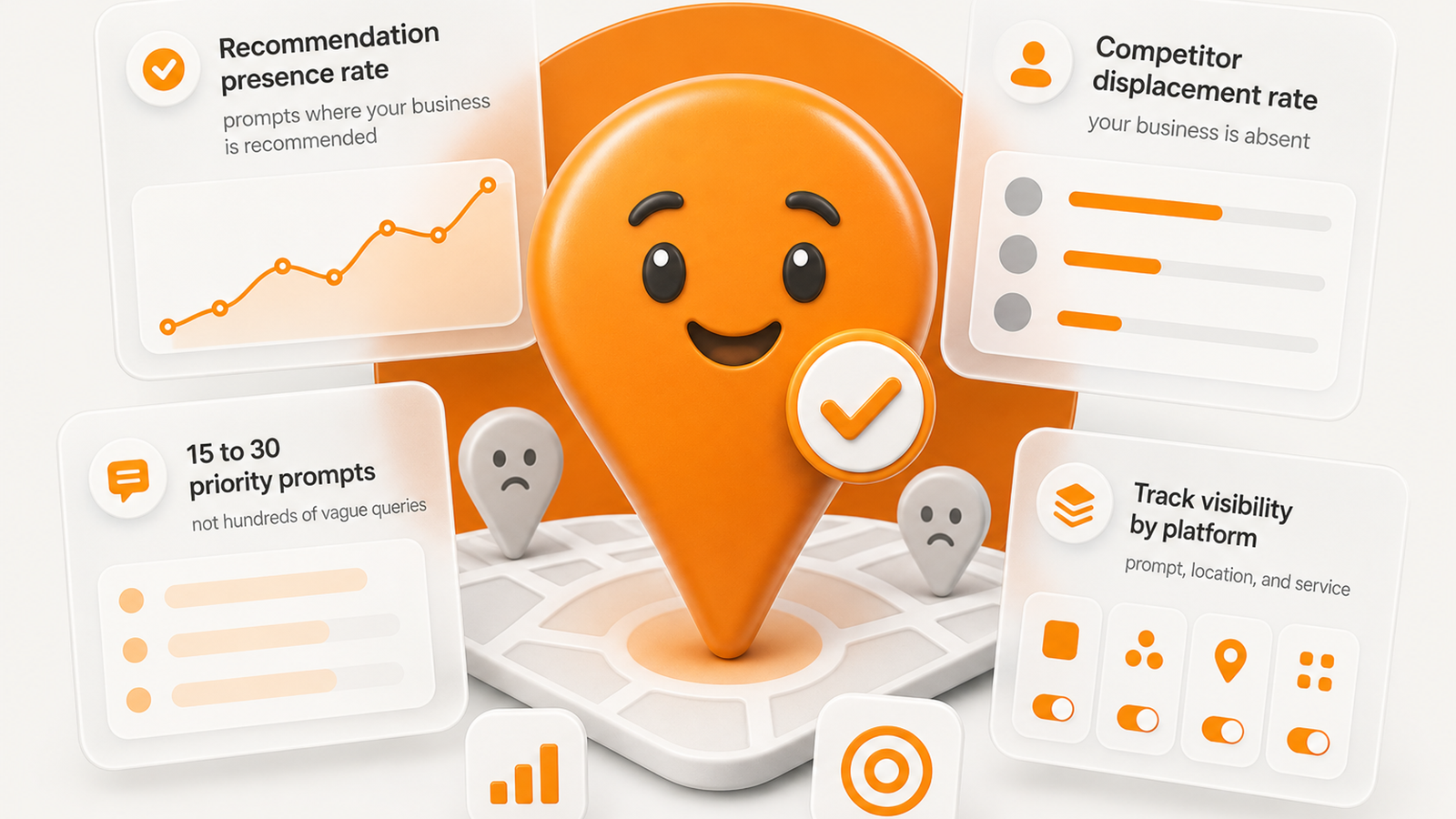
AI search visibility metrics should show whether your local business is recommended for customer-ready questions, which competitors appear instead, and whether the local signals behind those answers are improving. Track recommendation presence, competitor displacement, source inclusion, entity accuracy, and qualified outcomes by platform, prompt, service, and location.
Quick answer: For most local businesses, recommendation presence rate is the first AI search visibility metric to track. It measures the share of priority prompts where an AI assistant explicitly recommends your business or includes it in a relevant shortlist. Pair it with competitor displacement rate and local-evidence checks so the report leads to a specific next step.
Track AI answers within a documented set of prompts, platforms, markets, and dates. Report recommendation visibility separately from recorded calls, bookings, leads, and sales, then use the same documented conditions for each repeat check.
The AI search visibility metrics that matter
AI search visibility is the observed presence of a business in answers generated for relevant prompts on AI assistants and AI-led search experiences. For a local business, the meaningful question is not simply whether its name appears. It is whether the answer recommends the business for a specific service in a specific market.
This differs from three familiar measurements:
- Impressions show that a result may have been displayed. They do not show whether an assistant named or recommended the business.
- Organic and local-pack rankings measure placement in Google results. They do not capture every generated answer, its sources, or the competitors included in its shortlist.
- Referral traffic measures visits that reached your site. It misses customers who call, request directions, or choose a business without clicking. It also cannot explain why an assistant did not recommend you.
A useful measurement program repeats a defined set of prompts under documented conditions and compares the captured results over time.
| Metric | Definition | Calculation or tracking method | Cadence | Decision it informs |
|---|---|---|---|---|
| Recommendation presence rate | Priority prompts where your business is explicitly recommended or shortlisted | Recommended prompts ÷ eligible prompts checked × 100 | Weekly | Whether customers can discover you in tracked AI answers |
| Share of AI recommendations | Your recommendation appearances relative to tracked recommendation appearances | Your appearances ÷ all tracked business appearances × 100 | Weekly or monthly | Whether you are gaining ground against named competitors |
| Competitor displacement rate | Checks where a tracked competitor appears and you do not | Competitor-only checks ÷ eligible checks × 100 | Weekly | Which competitors and prompts need investigation |
| Prompt coverage | Coverage across service, market, intent, and platform segments | Count checks and results by segment | Monthly | Whether the measurement set reflects priority demand |
| Source inclusion rate | Checks where an exposed source includes your site or business listing | Source-included checks ÷ checks with visible sources × 100 | Weekly | Whether visible source evidence supports your business |
| Entity accuracy rate | Correct business facts in checked answers and listings | Accurate checked fields ÷ total fields checked × 100 | Monthly | Whether incorrect facts could reduce trust or conversion |
| Local evidence completion | Completion of selected profile, review, citation, schema, and content work | Completed priority items ÷ planned priority items × 100 | Monthly | Whether recommendation gaps have a documented remediation path |
| Qualified AI referral outcomes | Attributable calls, forms, direction requests, or revenue from AI-related visits | Track identifiable sessions and connected conversion events | Monthly | Whether recorded visibility-related traffic contributes to business outcomes |
Do not compress these into a single opaque score. A summary score can help with leadership reporting, but the underlying prompt, platform, competitor, source, and local-evidence detail is what helps a team decide what to change.
Start with recommendation presence, not raw mentions
A raw brand mention can be neutral, negative, historical, or unrelated to the service a customer needs. For local discovery, count a result as a recommendation only when the assistant presents the business as a suitable option for the stated service and location, or includes it in a relevant shortlist.
For example, an answer to “Who are reliable emergency plumbers in North York?” may name several businesses. If your business is named as an option, count that as a recommendation presence. If it is mentioned only in a cautionary comparison or as a source without being proposed to the customer, record that separately.
Define recommendation rules before checking
Create a written rule set before collecting results. It should state:
- Which prompt types qualify as decision-ready.
- What language counts as a recommendation or shortlist inclusion.
- Whether unranked list inclusion receives the same value as a lead recommendation.
- How to record ambiguous answers, source-only citations, and no-answer results.
- Which competitors belong in the tracked set.
This prevents the score from changing because the reviewer changed their interpretation.
Calculate recommendation presence rate
Use this formula:
Recommendation presence rate = prompts where your business is recommended ÷ total eligible prompts checked × 100
Keep the denominator clean. If a platform does not provide a local-business recommendation for a prompt, label it as a no-answer or ineligible result according to your predefined rules. Do not quietly remove unfavorable answers.
For example, a 40% presence rate means the business appeared in 4 of 10 eligible checks in that tracked sample. It does not mean 40% of all customers see or choose the business.
RankSimply monitors selected customer prompts across ChatGPT, Claude, Gemini, Perplexity, Grok, Copilot, and Google AI Overviews. It records observed answers, named competitors, and available citations so local businesses can compare the same prompts over time. See RankSimply’s AI visibility features.
Track visibility by platform, prompt, location, and service
A blended AI visibility number can hide the information needed to act. A dental practice may appear for “cosmetic dentist in Toronto” on one platform but not for “same-day emergency dentist near me” on another. Those are different customer needs and may require different supporting evidence.
Segment every tracked check by these four fields:
- Platform: ChatGPT, Gemini, Claude, Perplexity, Copilot, Grok, Google AI Overviews, and conventional Google results should remain distinguishable.
- Service: Use actual service lines, such as roof repair, family law, Invisalign, or kitchen renovation.
- Location: Record city, neighbourhood, service area, postal-code or ZIP-code target where relevant, and the test location or market setting.
- Buyer intent: Separate broad research prompts from decision-ready prompts such as “best,” “near me,” “open now,” “same-day,” “for first-time buyers,” or “with financing.”
Build a practical prompt set
Start with 15 to 30 priority prompts, not hundreds of vague queries. A balanced local-business set can include:
- Five high-intent service-and-city questions.
- Five service-area or neighbourhood questions.
- Five comparative or qualification questions.
- A smaller set of branded accuracy checks.
Avoid prompts that include your business name when measuring discovery. Those test recognition and entity accuracy, not whether a new customer would find you.
Keep the exact wording, date, market, platform, and result capture for every run. If you revise the prompt set, mark the change so an apparent trend is not really a methodology change.
Treat platform differences as useful evidence
AI assistants do not always present the same source detail, local context, or recommendation format. Some answers show visible citations, while others provide little or no source information. Google AI Overviews can also appear alongside organic results, local packs, and Business Profiles rather than replacing those results. RankSimply’s AI Overview tracker records AI Overview findings alongside local-pack and organic context for repeated queries and markets.
That means “not cited” should not be interpreted as “not considered.” Report source inclusion only for checks where the platform visibly exposes sources, and label unavailable source data as unavailable.
| Measurement area | AI recommendation tracking | Traditional local SEO tracking |
|---|---|---|
| Main question | Is the business recommended in an answer? | Where does the business rank in search results? |
| Unit of measurement | Prompt, answer, platform, market | Query, result position, market |
| Competitor signal | Named businesses in the answer | Businesses above or beside you in results |
| Source signal | Visible citations when exposed | Ranking URLs, links, indexed pages |
| Local evidence checks | Entity accuracy, reviews, citations, schema, content | Profile, rankings, reviews, links, content |
| Best use | Find recommendation gaps and answer evidence | Measure search-result performance and demand capture |
AI tracking should complement, not replace, local-pack rank tracking, Google Business Profile reporting, organic traffic analysis, and conversion measurement.
Measure whether AI systems recommend you or your competitors
Recommendation presence tells you whether you appear. Competitive metrics show who is taking the opportunity when you do not.
Track share of AI recommendations
Share of AI recommendations measures your appearances compared with all recommendation appearances among your tracked business and competitor set.
Use this formula:
Your share of AI recommendations = your recommendation appearances ÷ all tracked recommendation appearances × 100
For example, if 20 tracked answers contain 30 total business recommendations and your business appears six times, your share is 20% of those recorded appearances. Record the denominator and competitor set with every report. A share metric becomes misleading if the competitor list changes without notation.
A competitor can appear more than once in an answer, but count businesses consistently. In most local reports, one appearance per business per prompt is easier to interpret than counting repeated mentions in the same response.
Track competitor displacement rate
Competitor displacement rate captures occasions where a tracked competitor is recommended but your business is absent.
Competitor displacement rate = competitor-only checks ÷ total eligible checks × 100
Review this by competitor, service, location, and platform. A high displacement rate for one competitor on “emergency” prompts may point to a category, review-recency, service-page, or local-profile issue. It does not prove the competitor changed one particular signal or that one fix will change every answer.
RankSimply records which competitors are recommended instead of your business, along with the observed answer and available citations. That makes the next question more specific: where are they appearing, what facts and sources appear around the answer, and what evidence gap can the business address? See the AI visibility monitoring features.
Record source and citation inclusion carefully
Where sources are visible, record:
- Whether your website, Business Profile, directory listing, review page, or other business evidence appears.
- Whether a competitor source appears instead.
- The source type and destination URL.
- Whether the source supports the recommendation, a factual claim, or only general background.
Source inclusion is not the same as recommendation presence. A business may be cited without being recommended, or recommended without a transparent source list. Keeping the two metrics separate prevents a source-only citation from being reported as customer-facing visibility.
Track the local evidence behind AI recommendations
AI visibility is not just an answer-monitoring task. When recommendation presence falls, inspect the factual and reputational evidence that customers, search engines, directories, and AI systems can encounter.
Check business entity accuracy
Run a monthly accuracy check for the facts that should match across owned properties and important listings:
- Business name
- Address
- Phone number
- Primary category and services
- Service area
- Hours and holiday hours
- Website URL
- Review-related claims, including ratings or counts when displayed
Record each item as accurate, inaccurate, missing, or needs review. Do not publish or repeat numerical review claims without a dated source, because those figures change.
A name, address, or category mismatch may confuse customers even if it is not possible to prove its direct effect on a particular AI answer. The practical response is still clear: correct material inconsistencies on the profile, site, and relevant citations, then recheck the defined prompt set.
Measure the evidence work, not just the result
Use leading indicators to show whether the business has completed work associated with observed gaps:
| Evidence indicator | What to check | Example action when weak |
|---|---|---|
| Profile completeness | Categories, services, hours, photos, contact details | Update the Google Business Profile with verified details |
| Review quality and recency | Recent feedback themes and unanswered reviews | Request reviews appropriately and prepare accurate replies |
| Citation consistency | Material business facts match across priority listings | Correct mismatched name, address, phone, or URL data |
| Structured data coverage | Relevant business and service pages include valid markup | Add or correct business schema after technical review |
| Local content coverage | Pages answer real service-and-location questions | Create or improve distinct pages for uncovered buyer needs |
Use these indicators to document completed evidence work and connect each observed visibility gap to a specific remediation task.
RankSimply coordinates profile, review, citation, schema, competitor, and content work with recommendation findings. Its workflow compares observed results, competitor coverage, and buyer questions to prioritize distinct content and local-visibility tasks, then rechecks the same prompts and markets. See the AI Overview tracker and RankSimply features.
Separate AI visibility metrics from business-outcome metrics
A recommendation dashboard cannot prove revenue by itself. Keep visibility metrics and commercial outcomes in separate report sections, then connect them only where attribution is available.
Useful outcome metrics include:
- Qualified referral sessions from identifiable AI or search sources.
- Calls from tracked phone numbers or call events.
- Form submissions that include a usable source field.
- Direction requests and website clicks from local profile reporting.
- Bookings, consultations, or revenue when your CRM can connect the conversion to its source.
Google Analytics reports recorded website sessions and configured events after a user reaches your site. It cannot show every AI answer where your business was recommended, omitted, or cited without a click. Use analytics for recorded traffic and events, and use repeated answer monitoring for recommendation presence. For a fuller measurement framework, see how to measure AI search referral visibility.
When reporting outcomes, distinguish observed referral traffic from inferred influence. A customer may research through an AI assistant and later return through branded search, direct traffic, a phone call, or a map listing. Do not assign revenue to AI without a defensible attribution method.
A weekly and monthly AI search visibility tracking workflow
The goal is a repeatable operating review, not a dashboard that receives attention once per quarter.
Weekly: check priority prompts and triage changes
Each week, run the core prompt set under the same documented conditions. Review:
- Recommendation presence by platform and market.
- New competitor appearances and competitor displacement.
- Visible citations and sources where available.
- Entity errors, incorrect claims, or outdated business details in observed answers.
- Material changes in local-pack or organic context for the same services.
Flag changes, but do not react to one isolated result by rebuilding a website or changing every profile field. Look for a repeated pattern across comparable prompts or a material factual error that needs immediate correction.
Monthly: review trends and complete priority work
Use the monthly review to compare periods, inspect prompt segments, and assign next actions. A practical agenda is:
- Compare recommendation presence and displacement rates with the prior month.
- Identify the services and locations with the largest gaps.
- Review competitor appearances and visible source patterns.
- Complete an entity-accuracy and citation-consistency check.
- Review profile, reviews, schema, and content tasks completed during the month.
- Compare attributable traffic, calls, forms, and revenue where data exists.
- Keep, revise, or retire prompts that no longer represent customer demand.
Turn a visibility drop into a remediation plan
Use the observed gap to choose the next investigation rather than applying the same tactic to every problem.
| Observed gap | First investigation | Possible remediation path |
|---|---|---|
| Missing from service-and-city prompts | Service pages, category, service area, competitor evidence | Improve profile details, local content, citations, and supporting schema |
| Competitor appears repeatedly | Competitor services, reviews, sources, and local coverage | Prioritize the material evidence gaps found in comparison |
| Incorrect business facts in answers | Site, Business Profile, and priority listing accuracy | Correct owned facts and inconsistent citations |
| Source-only appearances without recommendations | Whether sources clearly establish relevance and service fit | Improve service proof, local relevance, and page clarity |
| Recommendation presence improves but leads do not | Landing-page fit, call handling, conversion tracking | Improve conversion path and verify attribution |
A simple scorecard should show the metric, current result, prior result, segment, evidence, owner, next action, and recheck date. That format makes it clear whether the team is tracking a visibility issue, completing a local-evidence task, or measuring a customer outcome.
For businesses that want a starting point, RankSimply offers a free AI visibility report with no signup. Request your free AI visibility report.
Frequently asked questions
What is the most important AI search visibility metric for a local business?
Recommendation presence rate is the most useful starting metric because it measures whether a business is explicitly recommended or included in a relevant shortlist for priority local prompts. Pair it with competitor displacement rate to see which businesses appear when yours does not.
How often should I track AI recommendation visibility?
Track a stable set of high-priority prompts weekly and conduct a fuller trend and evidence review monthly. Weekly checks can surface changes and factual errors; monthly reviews provide enough context to prioritize profile, review, citation, schema, and content work without overreacting to one answer.
Can I measure AI search visibility with Google Analytics alone?
No. Google Analytics can measure recorded website sessions and configured conversion events, including identifiable referral traffic. It cannot show every AI answer where your business was recommended, omitted, or cited without a click. Use analytics alongside answer monitoring and local-search reporting.
Why do AI answers recommend different businesses for similar prompts?
AI answers can change when prompt wording, location, available sources, product versions, and user context change. Compare repeated checks under documented conditions rather than treating one prompt result as a permanent ranking.
Should I track every AI platform separately?
Track platforms separately when they are relevant to your customers and measurement capacity. Separate reporting preserves the difference between an answer on ChatGPT, Gemini, Claude, Perplexity, Copilot, Grok, or Google AI Overviews. A blended score can help with a high-level summary, but it should not replace platform-level findings.